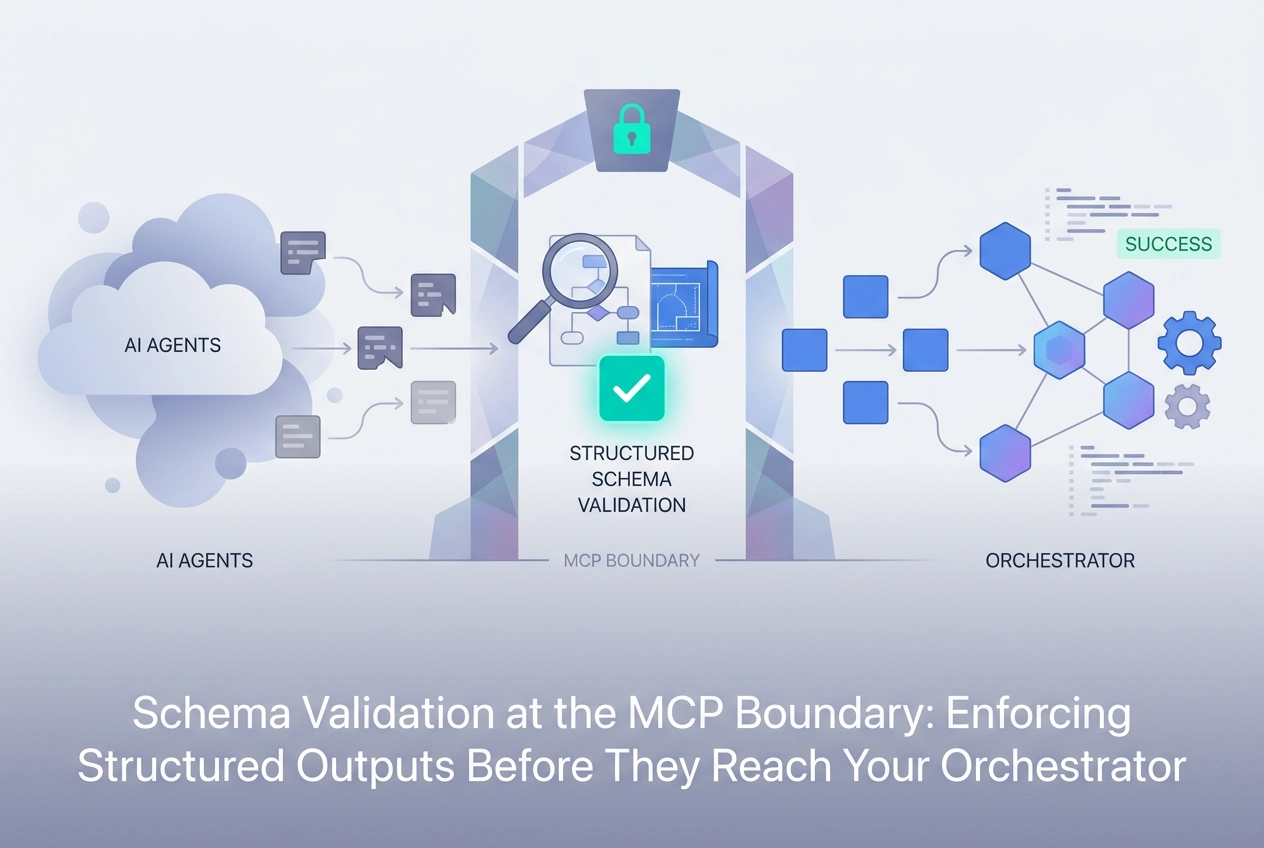
Silent failures are the most dangerous failures in distributed AI systems. Your orchestrator receives nothing, logs nothing meaningful, and the pipeline stalls without a trace pointing back to the real culprit: a tool response that never conformed to its schema contract.
Google's ADK changed the stakes here. With runtime Pydantic enforcement now active at the MCP boundary, tool responses that fail schema validation no longer degrade gracefully. They reject. If your ai agent frameworks aren't built around explicit output contracts at the tool boundary, that rejection surfaces as an upstream failure with no obvious origin point.
This tutorial walks through exactly how to prevent that. You will learn what a silent upstream failure looks like before you understand why ADK's runtime rejection permanently raises the production baseline. From there, the post covers how to write output contracts before tool logic, how to test those contracts locally before connecting a hosted endpoint, and what to do when a tool returns an unexpected shape in production. It also addresses discriminated unions, dynamic tool discovery, and where validation overhead matters most in token-constrained pipelines. Schema contracts are not optional polish. They are the baseline.

What a Silent Upstream Failure Actually Looks Like
A tool returns {"results": null} when the declared schema is results: list[SearchResult]. No exception fires at the call site. The MCP server hands off the payload, the orchestrator receives it, and the mapping layer either substitutes None for the missing list or drops the record without complaint. Two steps later, downstream code tries to iterate over null, the agent stalls, and the traceback points at the iteration logic, not at the tool that produced the bad payload.
That gap between cause and symptom is what makes silent schema violations expensive in a live ai agent workflow. You are not debugging a crash; you are reverse-engineering which upstream tool handed off a shape the orchestrator was never designed to handle.
The MCP boundary is the last control point where that can be caught cleanly. Once a response crosses from tool to orchestrator, the orchestrator assumes the contract is satisfied and has no reason to re-validate. If the tool ships a malformed payload, the orchestrator processes it in good faith and the failure propagates until something concrete breaks, usually far from the origin. Observable failure modes and traceability are hard requirements in production agent systems, not optional instrumentation.
Runtime enforcement inverts that dynamic. A validation error raised at the boundary is loud, located, and fixable. A None silently substituted three hops downstream is none of those things. The schema work costs an hour; the silent failure costs a debugging session with no clear starting point.
Why ADK Runtime Rejection Changes the Production Baseline
That failure pattern exists because nothing at the boundary said no. Google's ADK changes that.
ADK injects a Pydantic schema directly at the tool boundary and rejects any non-conforming response at runtime. The rejection is not configurable; it is the contract. In any pipeline built on pydantic ai agents, this makes output schemas mandatory rather than advisory. There is no "we'll add validation later" path when the framework itself refuses the payload.
FastMCP takes a different position. Its configurable validation modes include a lenient passthrough that lets malformed responses continue upstream. That flexibility has value during development, where strict enforcement interrupts iteration. In production ai agent architecture, the same flexibility means a contract violation reaches the orchestrator with no boundary signal. The payload propagates; the failure surfaces elsewhere.
This is an architectural decision, not a configuration detail. Choosing FastMCP's lenient mode in production is choosing late, quiet failure over early, loud failure. That choice must be deliberate.
The pain is not ADK-specific. CAMEL-AI's GitHub issue #3005 formally requests Pydantic decorator validation for MCP tools, confirming that boundary enforcement is an unresolved gap across multiple ai agent frameworks. Practitioners building on CAMEL-AI face the same problem ADK already solved.
Once ADK enforcement becomes the baseline expectation, any MCP-connected pipeline without explicit output contracts carries a standing risk: one upstream tool update that alters a response shape will break the agent silently. The production-readiness criteria most pipelines skip include exactly this gap. Explicit contracts are not polish; they are the minimum safe state.
Write the Output Contract Before You Write the Tool Logic
Once ADK enforcement is your baseline, the contract has to exist before the tool does. Writing it afterward means the schema describes what the tool happened to return, not what the orchestrator is allowed to receive.
Declare the response model at the top of the module, before the function body:
from pydantic import BaseModel, HttpUrl

class SearchResult(BaseModel):
 title: str
 url: HttpUrl
 snippet: str | None = None
That declaration is the specification. The tool implementation's job is to satisfy it, not define it.
Use the model as the return type annotation on the tool function, then attach it directly to the framework's decorator. In FastMCP, pass it as output_schema=SearchResult. In ADK, inject it as the output function. Both approaches publish the schema to any MCP client that introspects the tool list, giving the orchestrator a machine-readable contract it can validate independently. For more on how tools, resources, and prompts fit together structurally, see Anatomy of an MCP Protocol Server: Resources, Prompts, and Tools.
Run mypy --strict or pyright over the tool module before any client touches it:
pyright --strict tools/search.py
Type mismatches between what the function constructs and what SearchResult declares surface here, not at a hosted endpoint at 2 a.m.
Contract-first also pays compound dividends at scale. Across Moltline Studio's 160 tools on 22 MCP servers, defining the output model at tool definition time means a change to one server's response shape produces an immediate type error locally. Without that gate, every downstream agent becomes an implicit integration test that only fails in production.
Testing Schema Contracts Locally Before Wiring a Hosted Endpoint
Once the contract is defined, verify it before any agent touches it.
Run MCP Inspector against your local server first:
npx @modelcontextprotocol/inspector python server.py
This gives a live schema view and lets you exercise each tool's output contract interactively without a full agent loop.
For CI, skip the round-trip entirely. Call the tool function directly in a pytest fixture and assert the model validates cleanly:
def test_search_tool_schema(raw_tool_response):
 # raises ValidationError if the contract is broken
 MyResponseModel.model_validate(raw_tool_response)
This runs faster than any MCP transport layer and catches regressions before deployment.
To validate against a real production shape, paste https://mcp.moltlinestudio.com/<server> into the MCP Inspector's remote server field. It accepts Streamable HTTP with no account or API key. You can diff the published schema against your local Pydantic model before writing a single line of agent code. For more context, see The Shift to Model Context Protocol: Why Managed Infrastructure Matters.
Two additional guards belong in every test suite. First, treat extra fields as failures. Use model_config = ConfigDict(extra='forbid') on your response model; fields that slip through unaccounted are the most common source of silent contract drift.
Second, record a golden response fixture from the live endpoint during development and commit it to the repo. Run schema validation against that fixture in CI. Any upstream tool change that alters the response shape fails the fixture test before it reaches the orchestrator.
Discriminated Unions Break MCP Client Serialization
Even after local tests pass, a subtler class of schema bug waits at the client boundary.
Pydantic discriminated unions serialize to anyOf blocks with embedded $ref pointers in JSON Schema. The MCP protocol cannot round-trip that structure faithfully across all clients. Cursor forum threads document MCP servers causing client hangs when a discriminated union is exposed directly as a tool return type. The hang occurs during schema serialization, before any tool logic runs.
Before (causes hang):
Response = Annotated[Union[SuccessResult, ErrorResult], Field(discriminator="status")]
After (safe):
from typing import Literal
from pydantic import BaseModel, model_validator

class ToolResponse(BaseModel):
 """
 Flattened response envelope. Do not replace with a discriminated union;
 MCP clients cannot serialize the resulting anyOf/ref structure reliably.
 Invariant: if status == 'ok', data is not None. If status == 'error', error is not None.
 """
 status: Literal["ok", "error"]
 data: dict | None = None
 error: str | None = None

 @model_validator(mode="after")
 def check_invariant(self) -> "ToolResponse":
 if self.status == "ok" and self.data is None:
 raise ValueError("data required when status is ok")
 if self.status == "error" and self.error is None:
 raise ValueError("error required when status is error")
 return self
The tradeoff is real: you lose Python's type narrowing inside the tool implementation. The docstring carries that contract forward; without it, a future maintainer will reintroduce the union and rediscover the bug.
Schema failures are also client-specific. A schema that passes MCP Inspector may hang Cursor and pass Claude, or vice versa. Test every non-trivial schema against at least two clients before deploying.
When a complex schema is unavoidable, inspect what Pydantic generates before publishing:
import json
print(json.dumps(ToolResponse.model_json_schema(), indent=2))
Look for anyOf or $ref nodes and flatten them before the schema reaches a live endpoint. Understanding what makes a server MCP compatible at the protocol level helps identify which constructs will survive serialization across the full client surface.
Dynamic Tool Discovery Requires Runtime Output Function Generation
Flattening complex schemas solves the serialization problem when the tool list is known ahead of time. It does not solve the problem when it is not.
When an agent discovers MCP tools dynamically at startup, static output functions are not viable. The agent has no knowledge at code-write time of what schemas those tools expose. Every tool the agent queries at runtime could return a different shape.
The pattern: at startup, call tools/list, iterate each returned tool, read its inputSchema JSON Schema block, and generate a Pydantic model on the spot using create_model.
from pydantic import create_model

def python_type(schema_property: dict):
 mapping = {"string": str, "integer": int, "boolean": bool, "number": float}
 return mapping.get(schema_property.get("type"), str)

fields = {
 k: (python_type(v), ...)
 for k, v in schema["properties"].items()
}
DynamicModel = create_model(tool_name, **fields)
Wrap each tool call to validate before returning to the orchestrator:
raw = await call_tool(tool_name, arguments)
validated = DynamicModel.model_validate(raw)
This trades compile-time type safety for runtime contract enforcement at every discovered boundary. That is the correct tradeoff for any ai agent architecture that loads tools through MCP at connection time.
Cache the generated models. Key each model by tool name and a hash of its schema. On subsequent calls, skip construction entirely. Regenerate only when the tools/list response changes. Per-call create_model invocations add measurable overhead in high-throughput pipelines; caching eliminates it.
Log the schema on first discovery. Store the hash alongside the generated field list. When the upstream tool changes its schema, the hash mismatch triggers regeneration and writes a structured log entry before any malformed payload reaches orchestrator logic. Schema drift surfaces in logs, not in downstream failures.
What to Do When a Tool Returns the Wrong Shape in Production
Runtime discovery handles the case where you don't know the schema ahead of time. This section covers what to do when you know the schema and the tool ignores it anyway.
Catch ValidationError at the call site and log the raw payload. Never swallow it or convert it to None. Converting to None recreates the silent failure problem this pipeline is designed to prevent.
Return a typed error envelope instead of raising:
class BoundaryError(BaseModel):
 tool: str
 raw: str
 errors: list[str]
The orchestrator receives a structured value it can inspect, then decides whether to retry, skip, or escalate without crashing. Raising an unhandled exception removes that choice.
On second attempt, validate against a minimal fallback model that captures only the fields the current task strictly requires. If the fallback passes, proceed on reduced data and log the schema mismatch for async review. This keeps the agent running while flagging the divergence.
Emit structured logs that include the tool name, expected schema hash, actual response hash, and specific validation error fields. A JSON-structured logger or Logfire works here. Hashes make schema drift visible in a dashboard query without manual log triage.
Review production validation errors weekly. A tool failing schema validation above any consistent threshold means the upstream server changed its contract, not that your validation is too strict. For next steps on connecting this pattern to a real MCP server, the free endpoints at mcp.moltlinestudio.com/<server> give you a live target with no signup required.
Tool Count, Token Cost, and Where Validation Overhead Matters Most
Schema drift in production logs is one signal; the other is token overhead that compounds silently as your tool surface grows.
Cloudflare's API spans over 2,500 endpoints. Exposing each as a separate MCP tool would consume roughly 1.17 million tokens in tool descriptions alone. Their Code Mode pattern collapses that to two tools, a spec-search and a JavaScript executor, bringing the context footprint to approximately 1,000 tokens. Logfire made the same trade, reducing from 40+ hand-crafted tools to a minimal set focused on telemetry queries. Both sacrificed explicit surface area to reclaim context budget.
A 160-tool suite like Moltline Studio's takes the opposite position deliberately. More tools mean more schema overhead per request, but the agent never needs to write or execute code to reach a capability. The scaling problem here is token overhead, not tool availability, and the discipline is prioritization.
Not every tool warrants the same validation rigor. Apply strict output contracts first to tools called on every agent turn and to tools whose outputs feed multiple downstream steps. A one-off utility called once per session has lower risk than a search or query tool invoked repeatedly.
Schema complexity compounds the cost further. Deeply nested models inflate the tool description injected into every request. Flattening complex unions, as covered in the discriminated union section above, reduces per-tool token weight and applies that saving on every turn.
Before deployment, run Moltline Studio's free agent-readiness checker against any tool definition. It surfaces schema complexity and readiness issues without requiring a full pipeline wiring.
Schema Contracts Are a Production Baseline, Not a Polish Step
Prioritization is the right place to end, but prioritization without enforcement is just a plan. ADK runtime rejection converts that plan into a hard constraint: any MCP-connected pipeline missing explicit Pydantic schemas at the tool boundary is one upstream tool change away from a silent failure that surfaces nowhere useful.
The minimum viable path, compressed:
Define the Pydantic model before the tool logic. The schema is the spec; the implementation fills it.
Validate locally with MCP Inspector and
pytestbefore touching a hosted endpoint.Flatten discriminated unions before publishing; the serialization hang is real and client-specific.
Catch
ValidationErrorat the call site and return a typed error envelope. Never swallow it silently.
If your pipeline uses dynamic tool discovery, generate output functions at runtime from each discovered JSON Schema using create_model, cache them keyed by schema hash, and log the hash on first discovery. When an upstream tool changes shape, the hash mismatch surfaces in structured logs before it reaches orchestrator logic.
Start where damage is highest: tools with the highest call frequency and the widest downstream fan-out. A search or lookup tool called on every agent turn warrants strict contract enforcement first.
To see what a real production tool publishes before writing your first contract, paste any endpoint from mcp.moltlinestudio.com/<server> into the MCP Inspector. 110 tools are free with no signup, no API key. The schema is there immediately. Use it as a reference, then write your own contracts to the same standard.
Conclusion
Schema validation at the MCP boundary is not a refinement you add after your pipeline works. It is the foundation that determines whether failures surface as actionable errors or invisible corruption downstream.
The core takeaways are straightforward: define your Pydantic model before writing tool logic; validate contracts locally before deploying to any hosted endpoint; flatten discriminated unions to prevent client serialization failures; and always catch ValidationError at the call site with a typed error envelope.
Prioritize enforcement where it hurts most: high-frequency tools with wide downstream fan-out.
Your next step is concrete. Paste an endpoint from mcp.moltlinestudio.com/<server> into the MCP Inspector, study what a production-grade schema actually looks like, then write your first contract to that standard.
Structured outputs enforced at the boundary are what separate pipelines that degrade silently from pipelines that fail loudly and recover fast.