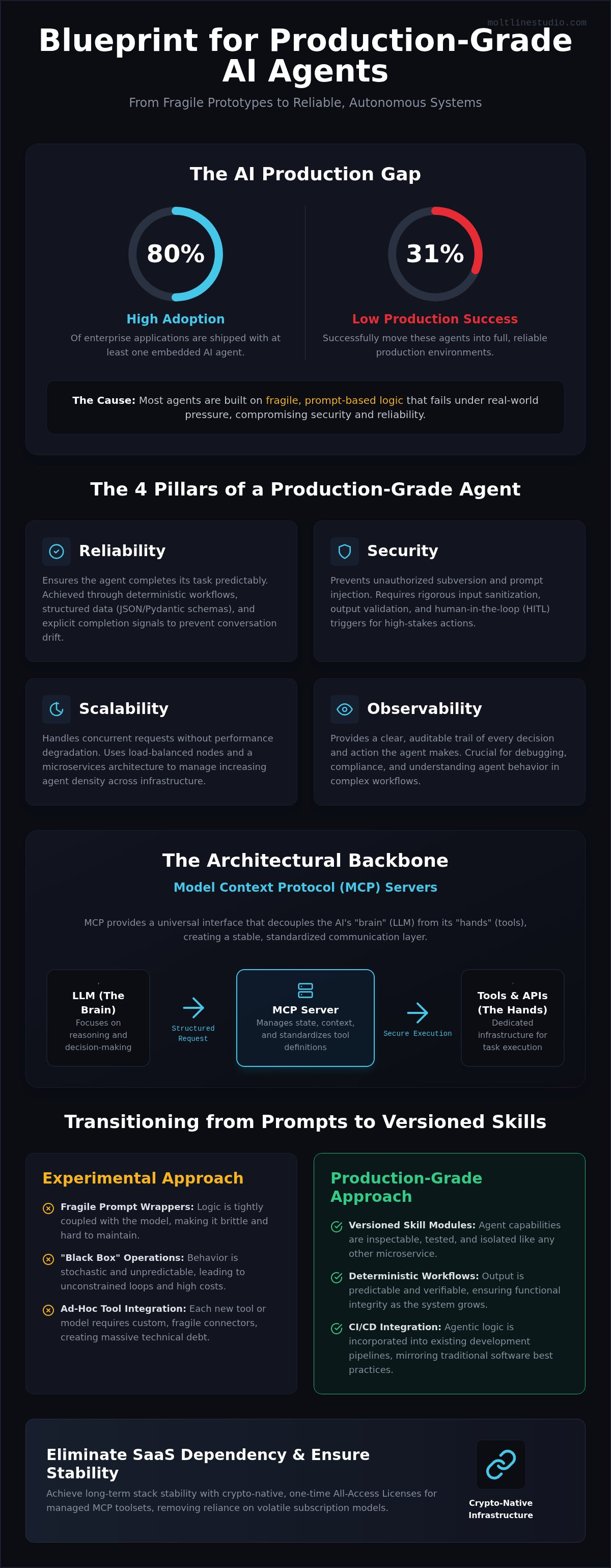
In the first quarter of 2026, 80% of enterprise applications shipped with at least one embedded AI agent. Despite this high adoption rate, only 31% of enterprises have successfully moved these agents into full production. The reason is simple. Most agents are built on fragile prompt-based logic that fails under real-world pressure. You've likely dealt with context drift in long conversations or agents losing track of complex, multi-step workflows. These aren't just bugs; they're architectural failures that compromise security and reliability.
Transitioning to production-grade AI agents requires a disciplined, engineering-first approach to infrastructure. This blueprint provides the technical requirements for building stable, reliable systems that survive adversarial conditions. You'll learn to implement a robust Model Context Protocol (MCP) architecture and deploy versioned, tested skills that mirror traditional software development best practices. We will cover the standards for injection-safe operations and the transition to "agentic ops" as a core discipline. It's time to replace experimental prototypes with resilient, crypto-native infrastructure and standardized protocols that ensure predictable outcomes.
Key Takeaways
- Transition from basic conversational chatbots to autonomous system operators by implementing the four pillars of reliability, security, scalability, and observability.
- Standardize your communication stack using Model Context Protocol (MCP) servers to effectively decouple model logic from the tool execution environment.
- Replace volatile prompt-based logic with versioned, adversarial-tested production-grade AI agents that integrate directly into existing CI/CD pipelines.
- Harden your infrastructure against prompt injection and unauthorized subversion by adopting rigorous input sanitization and output validation standards.
- Eliminate credit rationing and ensure long-term stack stability through flat-rate All-Access Licenses for managed MCP toolsets, payable in cryptocurrency.
Table of Contents
- Defining the Production-Grade AI Agent
- The Backbone: Model Context Protocol (MCP) Servers
- Beyond Prompts: Implementing Versioned Skill Architectures
- Hardening the Stack: Security and Injection-Safe Design
- Scaling with Moltline: All-Access Licenses and Crypto-Native Infrastructure
Defining the Production-Grade AI Agent
The industry is moving past the era of reactive chatbots. A true Intelligent Agent in a professional context functions as an autonomous system operator. It doesn't just answer questions; it executes complex tasks across disparate software environments. Experimental prototypes often rely on fragile prompt wrappers that break under high load or adversarial input. In contrast, production-grade AI agents are built on four non-negotiable pillars: reliability, security, scalability, and observability.
Reliability ensures the agent completes its task. Security prevents unauthorized subversion. Scalability allows the system to handle concurrent requests without performance degradation. Observability provides a clear audit trail of every decision made. Simple prompt-based logic is inherently stochastic. Production systems require a shift toward deterministic workflows where the output is predictable and verifiable. You can't run a business on a system that might decide to ignore its instructions because of a slight change in context drift.
Reliability and Determinism in Agentic Logic
Production stability depends on structured data. Using JSON or Pydantic schemas ensures that the agent's output is machine-readable and adheres to a strict contract. This eliminates the common problem of malformed data strings. Explicit completion signals are also vital. An agent must clearly state when a multi-step task is finalized or if it has reached a terminal error state. Goal-oriented architectures prevent conversation drift by keeping the model focused on the specific objective rather than the nuances of the chat history. This creates a predictable logic flow necessary for enterprise integration.
The Limitations of Experimental Frameworks
Frameworks like Auto-GPT demonstrated the potential for autonomy, but they are often too dangerous for enterprise deployment. Unconstrained loops can lead to catastrophic data loss or spiraling API costs. Production-grade AI agents require human-in-the-loop (HITL) triggers for high-stakes actions, such as financial transactions or database deletions. We're moving away from "black box" prompts. Instead, developers are implementing inspectable skill modules. These modules are versioned, tested, and isolated. This ensures that the agent's capabilities are as predictable as any other microservice in your stack. Transitioning to this modular approach is the only way to maintain functional integrity as your system grows.
The Backbone: Model Context Protocol (MCP) Servers
Model Context Protocol (MCP) has emerged as the industry standard for agent-tool communication. It provides a universal interface that separates the large language model from the execution of external tools. This decoupling is a prerequisite for production-grade AI agents. Without a standardized protocol, developers are forced to write custom, fragile connectors for every new model or tool integration. MCP eliminates this technical debt. It allows the LLM to request data or actions through a structured, predictable server environment. This architecture ensures that the "brain" of the agent remains focused on reasoning while the "hands" are handled by dedicated infrastructure.
Choosing between managed and self-hosted MCP servers involves a trade-off between latency and operational overhead. Self-hosting on local infrastructure minimizes the round-trip time for sensitive data retrieval and provides total control over the execution environment. Managed servers, however, simplify the scaling process and ensure high availability. Both approaches provide a standardized interface for complex data retrieval. This ensures the agent interacts with legacy systems through a secure, well-defined gateway rather than through ad-hoc API calls that are difficult to monitor and audit.
MCP Server Architecture for Developers
Developers utilize MCP to standardize tool definitions across providers like Anthropic and OpenAI. This ensures that a single skill module works across different model families without extensive refactoring. Dedicated protocol servers manage state and context. This prevents the context window bloat that occurs when tool definitions are stuffed directly into the system prompt. For high-load environments, load-balanced MCP nodes handle concurrent requests. This maintains performance as agent density increases across your infrastructure. You can deploy these nodes as microservices, allowing for independent scaling and maintenance of specific agent capabilities.
Integrating MCP into Existing Tech Stacks
Integrating MCP into existing tech stacks allows agents to interact with legacy databases and real-time APIs securely. By using isolated execution environments, you mitigate the risks associated with running unverified code. This architectural pattern aligns with technical guidance for building Secure AI Agents. It ensures that even if an agent logic is subverted, the underlying infrastructure remains protected behind a secure gateway. Engineering teams looking to accelerate deployment can leverage pre-configured MCP Servers to establish this backbone immediately. Using these gateways allows for granular permissioning. You can restrict an agent's access to specific database tables or API endpoints, enforcing the principle of least privilege in your production-grade AI agents stack.
Beyond Prompts: Implementing Versioned Skill Architectures
Standardized infrastructure requires more than just a protocol. It demands a fundamental shift in how we define agent logic. Relying on loose prompt packs is a liability in a professional stack. Prompts are volatile. Sensitive to model updates. Prone to regression. When a model provider tweaks their weights, your previously stable prompt might start hallucinating. This inconsistency prevents the deployment of reliable production-grade AI agents. The solution is to transition from loose prompts to versioned, immutable skill modules. This approach treats agent capabilities as software packages rather than simple strings of text.
Prompts vs. Versioned Skill Modules
Prompts are model-dependent and difficult to unit test. They lack clear functional boundaries. Versioned skills are treated as discrete software packages. Implementing Semantic Versioning (SemVer) allows engineering teams to track changes with precision. A MAJOR version indicates breaking changes in the input schema. A MINOR version adds new capabilities. PATCH versions address logic fixes. This structure enables rigorous regression testing within your CI/CD pipeline. It ensures that an update to the agent's logic doesn't break the entire system. Immutable. Model-agnostic. Tested.
Persona Bundles and Identity Management
Functional logic must be decoupled from identity. Persona defines the agent's tone. Skill defines its ability to execute a task. Mixing these two creates context bloat. It complicates debugging. Using dedicated Persona Bundles allows you to enforce consistent AI identities across different departments. These bundles act as a wrapper around the functional logic. They ensure the agent remains professional and aligned with brand standards. This separation ensures that identity doesn't interfere with the underlying agentic workflow. Clear boundaries. Predictable behavior.
Moltline Studio addresses this need through adversarial-tested AI Agent Skills. These are not simple text files. They are immutable components designed for specific, high-stakes tasks. By utilizing an All-Access License, teams gain a library of versioned skills that remain stable regardless of external SaaS volatility. This approach prioritizes functional integrity over experimental flexibility. It allows developers to build with confidence. Pinning these components to immutable versions under a flat monthly license ensures long-term operational stability. No per-call metering. No credit rationing.
Hardening the Stack: Security and Injection-Safe Design
Prompt injection is the most critical vulnerability for LLM-based systems in 2026. It allows users to bypass system instructions and exfiltrate sensitive data. For production-grade AI agents, "trusting the model" isn't a security strategy. You must assume the model will eventually follow a malicious instruction. Hardening the stack requires rigorous input sanitization and strict output validation protocols. This ensures the agent only executes commands within a predefined, safe logical boundary. You can't rely on the model to police itself. Real security is architectural, not linguistic.
Adversarial testing is a prerequisite for any production deployment. You must stress-test your agents against known injection vectors and edge cases that cause functional collapse. This process identifies where an agent's logic is fragile before a malicious actor does. Managed infrastructure plays a vital role here. By using standardized, pre-hardened components, you reduce the attack surface. This moves the security burden from the prompt engineer to the systems architect.
Mitigating Prompt Injection and Data Exfiltration
Defensive prompting is a weak first line of defense. It relies on the model's ability to resist manipulation. This is never guaranteed. Architectural sandboxing is the superior standard. By utilizing MCP servers, you create a natural security boundary. The LLM resides in an untrusted zone. The tool execution environment stays in a trusted, isolated zone. This prevents an injected prompt from gaining direct access to your file system or sensitive databases. Monitoring for anomalous behavior in real-time is also essential. If an agent suddenly requests a bulk data export or attempts to access unauthorized API endpoints, the system must trigger an immediate kill-switch. Functional integrity depends on these failsafes.
Safe External Library Integration
Integrating external agent skill libraries requires extreme caution. Many public repositories contain unverified code. This can introduce backdoors into your stack. You must evaluate the security of any external library, such as those found on aitmpl.com, before deployment. Using tested and verified skill bundles is a baseline requirement for enterprise operations. Production-grade AI agents should only run skills that have undergone rigorous adversarial testing. This ensures that the logic remains stable even when presented with confusing or malicious inputs.
Audit trails are mandatory for compliance. Every tool call and LLM decision must be logged in an immutable repository. This allows you to reconstruct the chain of events if a security breach occurs. You need to know exactly why an agent made a specific decision and which input triggered that action. This level of transparency is what separates an experimental toy from a production system. Secure your infrastructure with adversarial-tested components. Get the All-Access License for verified agent skills and managed MCP servers.
Scaling with Moltline: All-Access Licenses and Crypto-Native Infrastructure
Engineering teams building production-grade AI agents often face a significant hurdle: the volatility of SaaS. Credit-metered subscriptions create ongoing financial friction and operational risk. If a provider changes their terms, service tiers, or API rate limits, your entire agent stack is compromised. Moltline Studio reduces this risk with a flat monthly rate that is never metered per call. This ensures that the core components of your infrastructure stay pinned to versions you choose. By shifting from metered consumption to a fixed rate and immutable modules, you secure the functional integrity of your deployment against external market shifts.
Privacy is paramount for engineering teams handling proprietary data. Traditional payment gateways introduce unnecessary metadata trails and processing delays. Moltline Studio uses crypto-native procurement only, with cryptocurrency handled through NOWPayments for privacy, speed, and instant digital delivery. License keys are delivered immediately. This allows for rapid scaling of your agentic infrastructure without the administrative overhead of fiat-based corporate accounting. It's an engineering-first approach to procurement that mirrors the efficiency of the code itself.
The Flat-Rate License Advantage
Version pinning is the highest form of reliability. By securing an All-Access License, you replace metered per-call costs with a single flat monthly fee. This model allows for predictable budgeting. High-performance teams can allocate capital toward compute and development rather than usage charges that climb with every agent run. You pin the stack. You receive license keys for immediate use. On the individual license there are no usage-based tiers to monitor, and the team and company plans price seats openly at a flat monthly rate. This simplicity is essential for scaling production-grade AI agents across large-scale enterprise environments where cost-certainty is a requirement for deployment.
Getting Started with Moltline Studio Infrastructure
Building a robust stack requires tested, standardized components. The Moltline Studio catalog provides access to a comprehensive library of adversarial-tested AI Agent Skills and Persona Bundles. These components are designed to integrate seamlessly into a managed MCP server environment. You can navigate the catalog, select the specific skill modules required for your workflow, and deploy them within minutes. This modularity ensures that your agents remain focused and efficient. Each skill is isolated, versioned, and ready for integration into your existing CI/CD pipelines.
Deploying managed MCP servers with your license provides the secure boundary discussed in previous sections. You gain a standardized interface for tool execution that is decoupled from the LLM. This architecture is necessary for maintaining a secure, scalable production environment. You can establish your backbone today by visiting the studio. Secure your production stack with the Moltline Studio All-Access License and transition your agents from experimental prototypes to stable, professional systems.
Deploying the 2026 Production Standard
Moving AI agents from experimental sandboxes to the production floor requires a shift in engineering philosophy. It's no longer about finding the perfect prompt; it's about building resilient infrastructure. Standardizing on MCP servers ensures that your model reasoning remains isolated from tool execution. Implementing versioned, immutable skill modules allows for the rigorous testing and CI/CD integration necessary for production-grade AI agents. By decoupling identity from functional logic, you create a system that is both predictable and secure.
Moltline Studio provides the tested components needed for this transition. Through our All-Access License, you gain a comprehensive catalog of adversarial-tested skills and managed MCP server access. The rate is flat and monthly, with no per-call metering and no credit rationing. We offer instant, crypto-native delivery of license keys to ensure your stack remains stable and private. It's time to stop troubleshooting fragile wrappers and start deploying professional system operators who can handle high-load environments with functional integrity.
Get the All-Access License for Production AI Tools. Your infrastructure is ready for the next level of autonomy. Build with confidence.
Frequently Asked Questions
What exactly makes an AI agent 'production-grade' compared to a prototype?
A production-grade agent is defined by its reliability, security, and observability. Prototypes are often simple prompt wrappers that fail under high load or adversarial input. In contrast, production-grade AI agents utilize standardized protocols like MCP and versioned skill modules to ensure deterministic outcomes. They operate within strict architectural boundaries and include human-in-the-loop triggers for critical tasks. This engineering-first approach prioritizes functional integrity over experimental flexibility.
How do MCP servers improve the performance of AI agents?
MCP servers decouple model reasoning from the tool execution environment. This architecture reduces context window bloat by keeping tool definitions and state management outside the primary LLM prompt. By offloading complex data retrieval to specialized servers, agents maintain higher reasoning accuracy and lower latency. It provides a standardized interface that allows developers to scale tool access independently of the model provider or the underlying data source.
Why should I use versioned agent skills instead of just writing better prompts?
Prompts are inherently stochastic and sensitive to model weight updates. Writing better prompts doesn't solve the problem of regression. Versioned agent skills are immutable software components that undergo rigorous regression testing and CI/CD validation. This ensures that your agent's capabilities remain stable even when the underlying LLM evolves. Versioning allows for precise tracking of logic changes, making the agent's behavior as predictable as a traditional microservice.
Are Moltline's AI agent skills safe from prompt injection attacks?
Moltline's skills are adversarial-tested to mitigate the risk of subversion. We utilize architectural sandboxing through MCP servers to create a natural security boundary between the untrusted LLM and the trusted execution environment. While no system is entirely immune to every vector, our design emphasizes input sanitization and strict output validation. This prevents malicious user inputs from gaining unauthorized access to your file systems or sensitive internal databases.
Can I use my own LLM with Moltline's MCP servers and skill bundles?
Yes. The Model Context Protocol is an open, model-agnostic standard. It is designed to work seamlessly with any LLM provider that supports the protocol, including Anthropic, OpenAI, and various open-source models. Moltline's infrastructure provides the standardized tools and skills that these models can call upon. This flexibility allows you to swap model providers without refactoring your entire toolset or execution logic.
What are the benefits of a flat-rate license over a credit-metered AI subscription?
The All-Access License is $19 per month, billed monthly and cancellable at any time, and what it removes is metering: one key covers premium tools across all 22 servers with no per-call charges and no credits to ration. Cancel and the key simply expires at the end of the period. Monthly subscriptions introduce operational risks, such as service tier changes, rate limit adjustments, or spiraling API costs. By pinning modules to immutable versions on a fixed monthly rate, you ensure long-term stability and predictable budgeting. This model is preferred by high-performance engineering teams who want cost certainty rather than a bill that moves with every agent run. A free tier requiring no subscription, no account, no API key and no card is available alongside it, and autonomous agents can buy the same monthly licence machine-to-machine over x402.
How does the crypto payment and license delivery process work at Moltline?
Moltline accepts cryptocurrency only, handled through NOWPayments for privacy and instant fulfillment; there is no card checkout. You select your license, complete the transaction on-chain, and receive your digital license keys immediately upon confirmation. Paying in crypto skips card authorization entirely, and an autonomous agent can settle the x402 challenge at moltlinestudio.com/api in USDC on Base to buy the same month of access with no human in the loop. This streamlined procurement process allows developers to deploy production-grade AI agents instantly without waiting for traditional corporate accounting cycles or fiat-based payment delays.
What is included in the Moltline All-Access License for developers?
The All-Access License grants full entry to our managed MCP server catalog, persona bundles, and the complete library of versioned AI Agent Skills. It includes technical documentation for integrating these components into existing CI/CD pipelines and scaling them across enterprise environments. Developers receive all necessary credentials for instant deployment of adversarial-tested tools. This license is designed to be the foundational layer for any professional AI agent deployment.