Running a reference script in a local environment isn't a production strategy; it's a security liability. Most engineering teams realize that bridging the gap between LLMs and proprietary data silos requires more than a weekend project. You've likely felt the friction of fragmented custom integrations and the constant maintenance burden of self-hosted tools. Relying on an unverified model context protocol server for critical operations exposes your infrastructure to unnecessary risk and unpredictable downtime.
We agree that AI agents are only as effective as the data they can securely access. This guide provides the blueprint to master the architecture, security, and deployment of production-grade MCP servers. You'll learn how to implement the latest stateless architecture from the July 28, 2026, specification to ensure scalability. We'll examine how to move beyond basic tool-calling logic toward a unified protocol that offers reliability for enterprise-scale agents. From auditing server-rendered UIs to managing long-running asynchronous tasks, we cover the technical standards required for a robust AI infrastructure.
Key Takeaways
- Define the core primitives of Resources, Prompts, and Tools to establish a standardized interface for AI agents.
- Transition from vulnerable reference scripts to a production-grade model context protocol server to achieve enterprise-level reliability.
- Secure your infrastructure by implementing robust authentication and adversarial-safe skill architectures for all data connections.
- Reduce engineering overhead by evaluating the maintenance costs of self-hosted infrastructure versus managed deployment models.
- Access specialized AI agent skills through the Moltline Studio All-Access License to bridge data silos without custom integration logic.
Table of Contents
- Why MCP Servers are the Missing Link in AI Agent Architecture
- Anatomy of an MCP Protocol Server: Resources, Prompts, and Tools
- The Production Gap: Why Reference Implementations Aren’t Enough
- Securing and Scaling Your MCP Server Deployment
- Accelerating Development with Moltline’s Managed MCP Infrastructure
Why MCP Servers are the Missing Link in AI Agent Architecture
Frontier models operate in isolation. They possess vast reasoning capabilities but lack real-time access to your proprietary data. This is the "Silo Problem." Without a bridge, an LLM is a powerful engine without fuel. The Model Context Protocol (MCP) solves this by establishing a universal interface between AI models and data sources. It provides a standardized way for agents to interact with everything from local files to complex cloud databases.
Instead of building brittle, one-off API wrappers for every database or SaaS tool, developers now deploy a model context protocol server. This shift standardizes how agents discover and execute tools. It reduces engineering hours spent on custom tool-calling logic. The primary benefits are clear: seamless interoperability, reduced request latency, and agentic workflows that actually scale in production. By decoupling the model from the data source, you create a modular infrastructure where tools can be updated or replaced without retraining the agent.
The Evolution of AI Tool-Calling
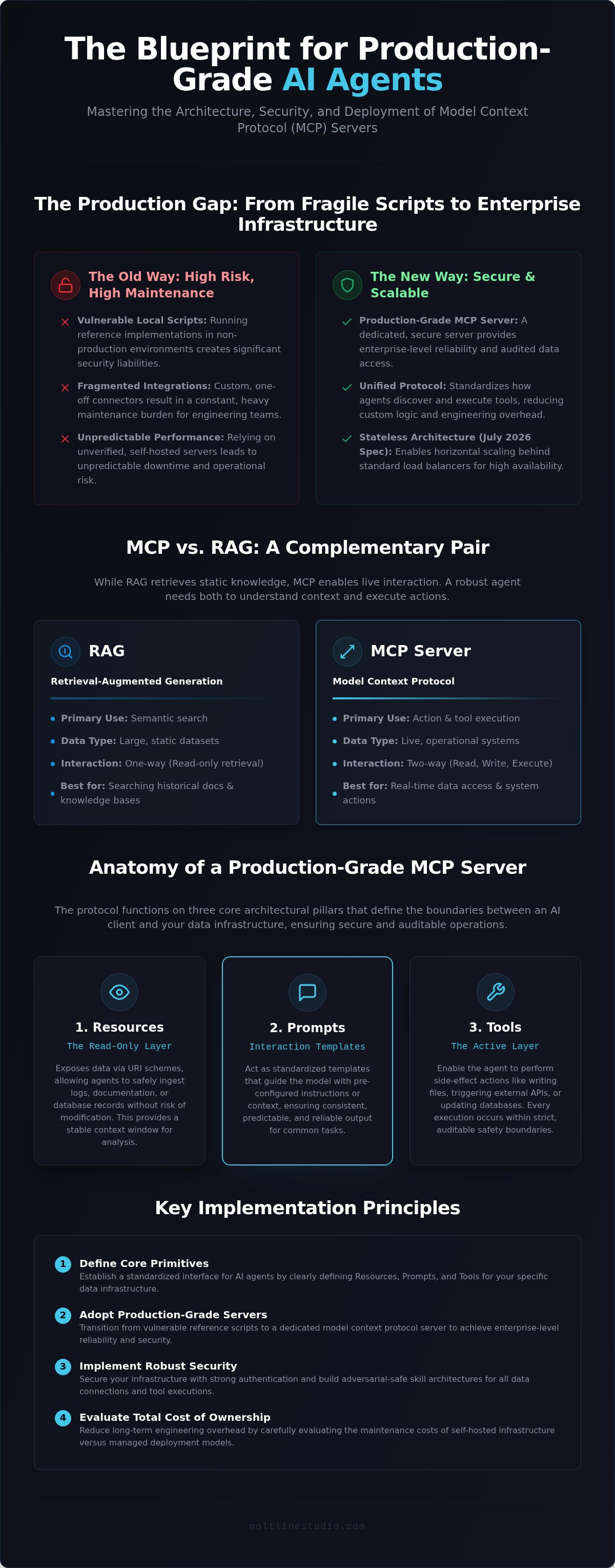
Tool-calling has moved beyond hard-coded function definitions. Early implementations required manual schema mapping for every external call. This approach is unmaintainable at scale. By 2026, the industry has pivoted to a "Protocol-First" architecture. The July 2026 update transitioned MCP to a stateless architecture, allowing servers to run behind standard load balancers. Dynamic protocol discovery means agents can now query a model context protocol server to understand available capabilities in real-time. This eliminates the need for static, pre-defined tool lists. It allows for a more flexible, resilient system that adapts to changing data environments.
MCP vs. Traditional RAG Pipelines
Retrieval-Augmented Generation (RAG) remains essential for searching massive, static datasets. However, vector databases are often too slow or too stale for operational data. MCP servers provide the two-way communication RAG lacks. While RAG retrieves context, an MCP server enables an agent to interact with live systems. This creates a functional loop where the agent doesn't just read data; it acts on it.
- Vector DBs: Best for semantic search across historical documentation.
- MCP Servers: Best for real-time data access and executing system actions.
These technologies are complementary. A production-grade agent uses RAG to understand the knowledge base and an MCP server to execute specific tasks. This combination creates a robust framework for agentic automation. It handles both knowledge retrieval and functional execution without the latency or complexity of traditional middleware solutions.
Anatomy of an MCP Protocol Server: Resources, Prompts, and Tools
A production-grade model context protocol server functions through three architectural pillars: Resources, Prompts, and Tools. These primitives define the operational boundaries between the AI client and your data infrastructure. Resources serve as the read-only layer. They expose data via URI schemes, allowing agents to ingest logs, documentation, or static database records without the risk of unauthorized modification. This provides the model with a stable context window for analysis.
Prompts act as standardized interaction templates. They guide the model by providing pre-configured instructions or context structures that ensure consistent output. Tools represent the active layer of the protocol. Unlike resources, tools enable the agent to perform side-effect actions. This includes writing files, triggering external API calls, or updating database entries. The July 2026 update from the Agentic AI Foundation emphasizes enterprise-grade security and governance within these primitives. This ensures that every tool execution remains within strict, auditable safety boundaries.
The Server-Client Handshake Process
System communication relies on the JSON-RPC 2.0 foundation. It's lightweight and transport-agnostic. During the initial connection, the client and server perform a capability discovery handshake. The server transmits a manifest of its available resources and tools. This allows for seamless protocol versioning and backward compatibility. Since the September 2025 registry launch, this dynamic discovery process has eliminated the need for static configurations. It ensures that agents always interact with the most current server capabilities without manual intervention.
Building Custom Server Logic
Engineers generally select between the TypeScript and Python SDKs for development. Both reached 1 billion total downloads in July 2026. TypeScript offers advantages for web-integrated environments. Python remains the preferred choice for data-intensive agentic workflows. Modularity is essential for high-performance deployments. Decouple your connection handling from your core business logic to simplify testing and auditing. When exposing sensitive enterprise datasets, implement granular permissioning at the tool level. For teams requiring immediate, high-security deployments, utilizing pre-built MCP servers can significantly reduce development lead times.
High-performance logic requires strict adherence to the stateless architecture defined in the latest specification. This allows your model context protocol server to scale horizontally across cloud-native environments. It also simplifies integration with standard load balancers. Prioritize adversarial-safe skill architectures to prevent prompt injection from triggering unauthorized tool actions. This engineering-first approach ensures that your infrastructure remains resilient under production loads.
The Production Gap: Why Reference Implementations Aren’t Enough
Reference scripts found on GitHub serve as excellent educational primers. They aren't production ready. These implementations often rely on local stdio transports that fail under concurrent load. A production-grade model context protocol server requires more than basic connectivity. It must handle connection pooling, state management, and robust error recovery. Reference implementations lack the hardened logic necessary to survive adversarial environments or high-traffic agentic workflows. Relying on them for enterprise data access is a significant operational risk.
Performance bottlenecks emerge quickly in non-optimized environments. Standard reference scripts often process requests sequentially. This creates significant latency as agent complexity grows. Research into a framework for advancing multi-agent systems highlights the need for asynchronous execution and standardized resource management. Without these optimizations, your AI infrastructure will struggle with timeouts and inconsistent response times. High-performance servers must implement horizontal scaling to maintain reliability as request volumes increase.
Reference vs. Production-Grade Servers
Enterprise environments demand sophisticated retry logic and graceful degradation. A reference script might crash on a malformed JSON-RPC 2.0 request. A production server validates every schema before processing. Versioned skill architectures are mandatory for long-term stability. They ensure that model updates don't break existing data connections. Running tools locally works for a solo developer. It fails in collaborative team settings where shared state, audit logs, and centralized governance are required for compliance.
Adversarial Safety in Protocol Communication
Unhardened MCP tools are primary targets for prompt injection. If a model is manipulated into sending malicious commands, the server must intercept them. Sanitizing inputs before they reach internal databases is a non-negotiable requirement. Rate limiting and resource quotas prevent agents from exhausting system resources during recursive loops. Injection-safe logic in an MCP context refers to the programmatic validation and sanitization of model-generated tool arguments to prevent unauthorized system execution.
Maintenance debt is the hidden cost of the self-hosted model context protocol server. Managing a fragmented collection of local scripts leads to version drift. Every update to the MCP specification requires manual intervention across your entire stack. This engineering overhead diverts resources from core product development. Production-grade infrastructure offloads this burden through managed environments and standardized deployment patterns. It replaces fragile scripts with resilient, tested systems designed for 24/7 operation.
Securing and Scaling Your MCP Server Deployment
Transitioning a model context protocol server from a local sandbox to a production environment requires a rigorous security posture. Basic connectivity isn't enough. You need mutual TLS or robust API key management to ensure only authorized clients communicate with your data infrastructure. Monitoring is equally critical. You must log every tool execution and resource request to maintain a clear audit trail of agent behavior. This transparency is vital for debugging recursive loops and identifying potential prompt injection attempts before they escalate into system-wide issues.
Self-hosting offers total control but introduces significant operational overhead. You're responsible for patching, version control, and infrastructure scaling. Managed infrastructure offloads these burdens. It allows your team to focus on agent logic rather than server maintenance. For most enterprises, the decision hinges on whether they want to build a data connector or an AI product. Managed hosting provides the stability required for high-stakes automation without the constant need for manual intervention.
Managed MCP Infrastructure: The Case for Stability
Engineering teams often underestimate the "DevOps tax" associated with custom AI tools. Maintaining 99.9% uptime for a self-hosted model context protocol server requires dedicated resources and constant monitoring. Managed environments solve this by providing automated failover and dynamic resource allocation. They scale based on protocol demand. This ensures that agentic workflows remain responsive during peak usage. The DevOps tax includes more than just server costs; it encompasses the engineering hours spent debugging transport layer issues and protocol version drift. Managed environments provide a stable abstraction layer that evolves alongside the MCP specification.
Integrating with Enterprise Systems (Google Drive, Slack, GitHub)
Bridging legacy silos like Google Drive, Slack, and GitHub requires secure credential handling. Your server must manage OAuth flows and token refreshing without exposing secrets to the LLM. When integrating with these systems, the server acts as the security gatekeeper. It translates high-level agent requests into scoped API calls. This prevents the model from overreaching its intended permissions. Multi-tenant configurations add another layer of complexity. You must ensure strict data isolation between different users or departments. Best practices involve using environment-specific vaults for secret management and implementing granular scopes for every integrated tool.
Building this infrastructure from scratch is a massive undertaking for most development teams. If you want to bypass the engineering bottleneck, you can get production-grade MCP servers that are ready for immediate deployment. This allows you to focus on building agent skills rather than managing the underlying protocol logic.
Accelerating Development with Moltline’s Managed MCP Infrastructure
Scaling AI agents requires shifting focus from prompt engineering to functional capability. While reference scripts provide a starting point, they don't offer the stability needed for production environments. Moltline Studio bridges this gap by providing managed AI agent skills and production-grade infrastructure. By utilizing an All-Access License, teams gain immediate entry to a suite of specialized tools designed for high-stakes automation. This approach ensures your model context protocol server remains resilient, secure, and fully optimized for enterprise data silos.
The transition from experimental scripts to versioned, injection-safe personas happens in minutes. Moltline prioritizes adversarial-safe skill architectures. This prevents the common security risks associated with unhardened tool-calling logic. Our infrastructure handles the complexities of protocol versioning and transport layer stability. This allows your developers to build agents that perform reliably under adversarial conditions. The ROI is clear: a flat monthly licence fee with nothing metered per call replaces the credit rationing of usage-based SaaS and the hidden costs of self-hosted maintenance debt.
Streamlined Access via Cryptocurrency
Efficiency is central to our delivery model. We accept cryptocurrency, handled through NOWPayments, and there is no card checkout; payment gives you instant license delivery. Once the transaction is verified, you receive your license key immediately. Engineering teams benefit from a flat-rate architecture. It provides long-term stability and predictable costs. This model respects the autonomy of builders who would rather not ration agent calls against a credit balance. One flat monthly fee covers every server, and nothing is metered per call.
Moltline’s Commitment to Engineering Integrity
We reject marketing hyperbole. Our engineering-first perspective focuses on the functional boundaries and safety of the technology. We don't promise magic; we deliver stable, tested infrastructure for professional environments. Every skill in our catalog undergoes thorough testing to ensure it meets technical standards for reliability. We prioritize substance over aesthetics. This ensures that your agents have the logical frameworks necessary to execute complex tasks without failure.
- Injection-Safe Personas: Hardened agent identities that resist prompt manipulation.
- Specialized Agent Skills: Pre-built functional blocks for immediate data integration.
- Managed Protocol Logic: Servers that adhere to the latest 2026 stateless specifications.
By removing the DevOps burden, Moltline allows you to deploy a model context protocol server that is ready for immediate integration with your existing systems. We understand the intricacies of deployment. We value long-term stability and ethical data handling. This disciplined innovation is what sets our managed infrastructure apart from standard reference implementations. Focus on the agentic logic that drives your business. Let us handle the protocol integrity. To begin, secure your production stack with a Moltline All-Access License.
Operationalizing Your Agentic Infrastructure
Deploying a production-grade model context protocol server is the final step in moving from AI experiments to functional automation. Reference scripts fail under load. Production environments require stateless, hardened architectures. Engineering rigor is non-negotiable. You've identified the gap between local prototypes and scalable systems. Focus on building high-value agent logic while we handle the protocol integrity.
Moltline Studio offers a definitive path to stable infrastructure. Our managed environment provides injection-safe agent skills and production-grade performance. We've eliminated the DevOps tax. We prioritize your autonomy with a flat monthly licence, payable in cryptocurrency. There is no per-call metering and no per-seat overhead. We provide reliable tools for professional builders who value efficiency and functional integrity. This is the foundation your agentic workflows deserve.
Get the All-Access License for Managed MCP Servers and start scaling your production AI stack today.
Frequently Asked Questions
What is the primary difference between an MCP client and an MCP server?
The MCP client is the host application, such as an LLM interface or agentic framework, that initiates requests. The server acts as the data provider or tool executor. Clients discover capabilities through a manifest transmitted during the initial handshake. This decoupling allows the client to interact with diverse data sources without requiring custom code for every individual integration or API.
Can I use MCP servers with LLMs other than Claude?
Yes, the protocol is an open standard governed by the Agentic AI Foundation. Any model supporting tool-calling can interface with a model context protocol server. This includes OpenAI, Google Gemini, and open-source models. The July 2026 update transitioned the protocol to a stateless architecture, making it easier for various model providers to integrate MCP into their standard inference pipelines.
How does the Model Context Protocol handle data privacy and security?
Security is managed through scoped access and transport-layer encryption. Servers define specific Resources and Tools, ensuring the model only accesses data necessary for the current task. Production-grade deployments implement granular permissions and input sanitization. This prevents unauthorized system execution. Managed infrastructure adds another layer of safety by using adversarial-safe skill architectures to intercept and block potential prompt injection attempts.
Is it possible to run MCP servers locally for development?
Developers frequently run servers locally using stdio transports for rapid prototyping and debugging. This setup allows you to test tool logic in an isolated environment before cloud deployment. While local execution is useful for development, it lacks the scalability, audit logging, and high availability required for enterprise workflows. Transitioning to cloud-native infrastructure is necessary for collaborative team settings and production-level reliability.
What are the most common use cases for MCP servers in 2026?
By 2026, use cases have expanded to include real-time cloud infrastructure management and automated code reviews. Agents use the protocol to sync live data between CRMs and internal knowledge bases. Stateless architecture allows these servers to handle high-traffic workloads behind standard load balancers. Common applications involve bridging legacy data silos, such as Google Drive or GitHub, with LLMs to perform complex, multi-step agentic tasks.
How do I upgrade from a reference GitHub server to a production-grade managed server?
Upgrading involves replacing brittle reference scripts with versioned, cloud-native instances. You must move from sequential stdio processing to asynchronous execution to handle concurrent agent requests. A production-grade model context protocol server requires robust error recovery and schema validation that reference scripts lack. Moltline provides a streamlined path for this transition by offering tested, injection-safe infrastructure that replaces fragile educational examples.
Does Moltline Studio support custom MCP server development?
Moltline Studio provides production-grade servers and AI agent skills through an All-Access License. We don't offer custom AI consulting or bespoke development services. Our focus is on delivering standardized, high-performance tools that engineering teams can deploy immediately. This model ensures you receive stable, tested logic without the long lead times or high costs associated with custom software engineering projects.
What cryptocurrencies are accepted for Moltline All-Access Licenses?
We accept major digital currencies including Bitcoin, Ethereum, and Solana. Utilizing cryptocurrency allows for instant license delivery. The licence itself is $19 per month, billed monthly and cancellable at any time; what it avoids is per-call metering and per-seat fees, not recurring billing. Once the transaction is confirmed on the blockchain, your license key is delivered immediately for production use in your AI stack.