Relying on unvetted, public repositories for your AI agent skills is an invitation for production outages and security breaches. You've likely experienced the friction of unpredictable per-call costs and the total lack of version control in standard Model Context Protocol implementations. Securing a dedicated MCP server license is the only way to move beyond these experimental vulnerabilities. It's difficult to build sophisticated logic when your infrastructure relies on third-party libraries that change without notice. These dependencies create high-risk environments where one unvetted update can compromise an entire system.
This technical guide provides a roadmap to securing the licensing required to stabilize your production-grade AI infrastructure. You want predictable costs and injection-safe agent skills that don't fluctuate with vendor pricing shifts. We'll examine how to move beyond brittle setups toward managed MCP servers that prioritize functional integrity and rapid deployment. By the end of this article, you'll understand how to secure a versioned, licensed stack that eliminates per-call metering and credit rationing and provides a hardened foundation for your AI operations.
Key Takeaways
- Identify the shift from experimental prompt packs to production-grade agentic infrastructure using standardized data-context servers.
- Evaluate the risks of unmanaged open-source repositories and learn how to secure a flat-rate MCP server license to eliminate unpredictable per-call billing.
- Replace variable, per-call SaaS infrastructure costs with a flat monthly license for your AI agent control plane.
- Implement managed or self-hosted deployments using hardened authentication protocols and injection-safe skill libraries.
- Deploy the 2026 production stack instantly in cryptocurrency for immediate access to version-controlled persona bundles and servers.
Table of Contents
- Understanding the MCP Server License Landscape in 2026
- Commercial vs. Open-Source MCP Licensing Models
- Engineering the Production Stack: Flat-Rate Licenses vs. Metered Fees
- Technical Requirements for Implementing Licensed MCP Servers
- The Moltline All-Access License: A Professional Solution
Understanding the MCP Server License Landscape in 2026
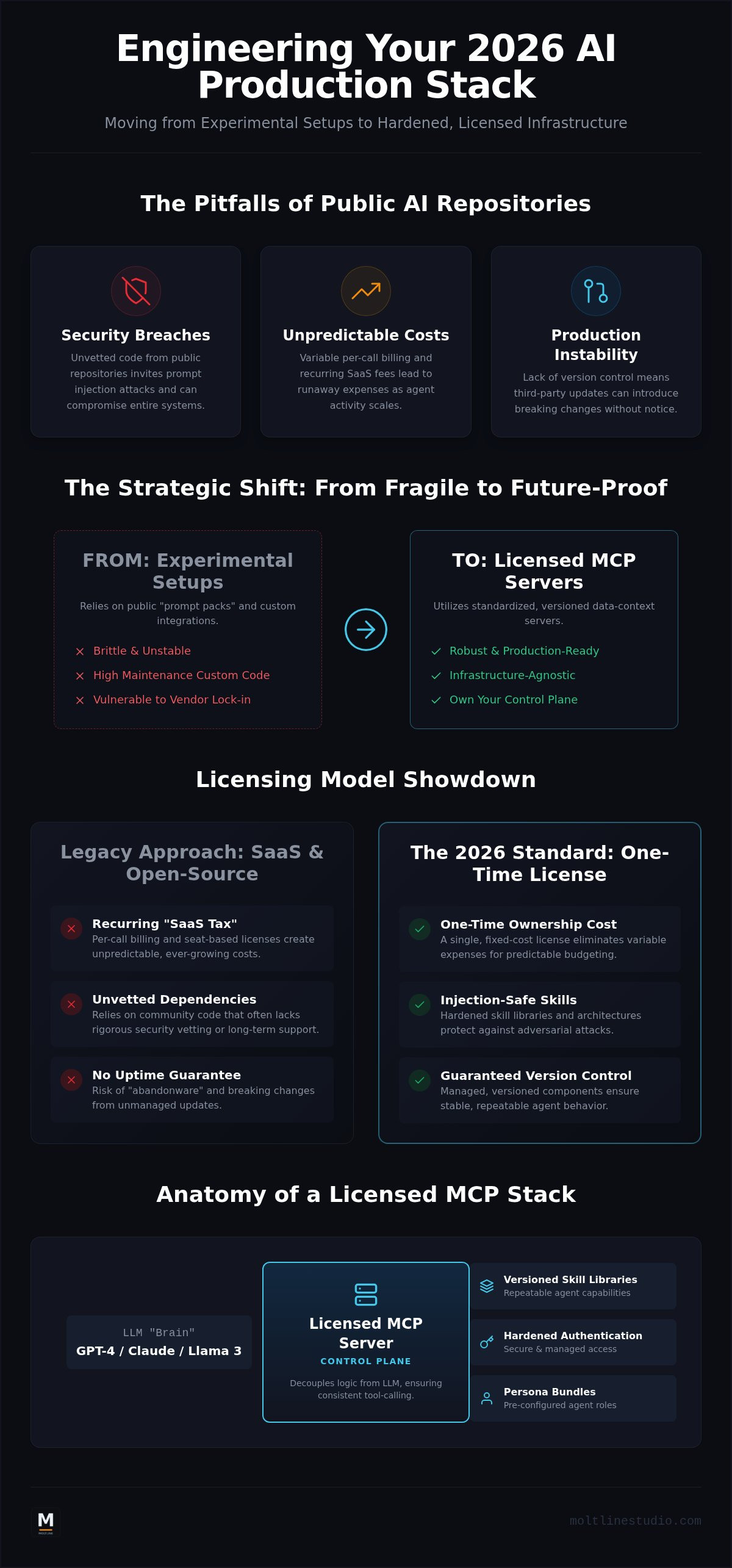
An MCP server license is a technical prerequisite for teams deploying autonomous agents at scale. It grants legal and technical access to standardized data-context servers. The era of experimental "prompt packs" is over. Production environments now require agentic infrastructure that is versioned, tested, and secure. Standardized protocols are rapidly replacing custom LangChain integrations. This shift occurs because custom codebases are difficult to maintain across multiple model updates. Engineering teams are moving toward infrastructure-agnostic solutions that don't lock them into a single provider's ecosystem.
Understanding various software licensing models helps engineers distinguish between ephemeral scripts and hardened commercial tools. Securing an MCP server license includes server access, versioned skill libraries, and persona bundles. These components ensure that an agent's capabilities are predictable and repeatable. Without a formal license, you're depending on logic that can be broken by a third-party update at any time. Reliable systems require a versioned, vetted control plane.
The Role of MCP in Agentic Workflows
MCP standardizes how LLMs interact with local and remote data. It effectively decouples the "brain", the LLM, from the "hands", the MCP tools. This separation is critical. It ensures consistent tool-calling behavior regardless of the underlying model. Whether you deploy Claude, GPT-4, or Llama 3, the interface remains constant. This abstraction layer simplifies the stack and reduces integration debt. It allows developers to swap models without rewriting the entire data-fetching logic. Managed servers ensure this link remains active and authenticated under high load.
Why Licensing Matters for Production Stability
Public repositories frequently lack version control. This leads to breaking changes when a contributor modifies a core function. Licensed servers provide uptime guarantees and rigorous security vetting. Managing adversarial risks is a primary concern for enterprise teams. Licensed MCP servers utilize injection-safe skill architectures to prevent prompt injection attacks. This level of protection is rarely found in unmanaged public libraries. It ensures that your agent infrastructure remains stable under adversarial conditions. Professional teams prioritize this robustness over the "free" but fragile nature of unvetted code. Stable production environments require predictable outcomes. Licensing provides the governance framework necessary to achieve this at scale.
Commercial vs. Open-Source MCP Licensing Models
Selecting an MCP server license requires a choice between open-source flexibility and commercial reliability. MIT and Apache 2.0 licenses are ubiquitous in the experimental phase. They allow for rapid prototyping and low-barrier entry. However, unmanaged open-source servers introduce significant risks to critical systems. Community-driven projects often lack rigorous security vetting. They frequently suffer from "abandonware" status when maintainers lose interest. For production-grade AI agent infrastructure, this instability is unacceptable. Relying on unvetted codebases can lead to catastrophic failures during model updates.
Many enterprise cloud platforms typically favor per-call billing or seat-based SaaS models. Usage-based AI pricing can lead to unpredictable infrastructure costs as agent activity scales. These "hidden" costs accumulate rapidly in complex agentic workflows. Engineers often face friction from seat-based licensing that doesn't align with agile deployment cycles. This is why a flat-rate All-Access License is emerging as the 2026 standard for independent studios. It provides a fixed-cost alternative to the variable expenses of cloud-native AI services.
The Hidden Costs of AI SaaS Subscriptions
Credit-based SaaS models often force developers to ration agent calls. This constraint hinders comprehensive testing and limits optimization cycles. Seat-based licensing adds administrative overhead that slows down engineering teams. It's an inefficient approach for modern AI infrastructure. Moving toward AI agent skills without subscription keeps that rationing out of your control plane. A flat monthly license eliminates the per-call "tax" on every agent interaction, and 110 of the 160 tools are free forever with no account, no API key and no card. This flat-rate model provides the financial predictability required for long-term project viability. An autonomous agent can buy the same monthly licence over x402 at moltlinestudio.com/api, settled in USDC on Base with no human in the loop; it is the month that is bought, not a single call.
Open-Source Limitations for Enterprise Agents
Open-source MCP implementations often lack standardized security protocols. Community-driven skills are rarely tested against adversarial prompt injection. In a production environment, you need versioned, tested logic frameworks. You cannot rely on a GitHub repository that might change its API overnight. A professional MCP server license ensures that your skill library is hardened and ready for deployment. It provides the stability that "free tier" tools simply cannot match. Engineering teams need the assurance that their tools will perform under adversarial conditions. Moltline Studio provides version-controlled, managed solutions for teams that value stability. You can secure your production stack today with an All-Access License.
Engineering the Production Stack: Flat-Rate Licenses vs. Metered Fees
Building a resilient production stack requires financial clarity. Standard SaaS models introduce variable friction into the agentic control plane. Every API call becomes a line item. This makes budgeting for high-performance teams nearly impossible. An MCP server license provides an alternative through flat monthly procurement. You pay one predictable fee. Nothing is metered per call. This shift from variable to fixed cost changes the engineering math. It allows teams to focus on optimization rather than cost-containment.
Predictable, unmetered pricing is the way to secure long-term stability. Credit-metered models are brittle. They depend on the financial health and pricing whims of a third-party provider. If a SaaS vendor pivots or hikes fees, your entire agentic infrastructure is at risk. High-performance teams cannot operate under those conditions. They need a hardened foundation that exists within their own deployment environment. Predictable infrastructure is a prerequisite for professional automation.
Securing Your Stack with Flat-Rate Licensing
Flat-rate licenses drastically reduce the Total Cost of Ownership (TCO). You pay one fixed monthly fee and eliminate the per-call tax. This model protects your budget against the volatility of the AI infrastructure market. GPU overhead and shifting venture capital demands often force SaaS companies to increase prices without notice. A flat-rate license keeps your per-call cost at zero for as long as it is active. It ensures that production-grade AI agents remain functional regardless of external market shifts. It's a strategic move for infrastructure resilience. The license auto-renews monthly, can be cancelled at any time, and on cancellation the key simply expires at the end of the paid period.
Crypto Payments for AI Infrastructure
Procurement must match the speed of your development cycle. Traditional fiat payments involve bank delays and international processing friction. Global engineering teams need immediate access to their tools. Crypto-native payments streamline this entire flow. You pay in cryptocurrency. You receive your digital key instantly. Crypto settlement removes the international banking bottleneck entirely. This efficiency allows for immediate deployment. You move from procurement to production in seconds. It provides privacy and speed that legacy financial systems cannot match. Digital-native infrastructure deserves digital-native payment protocols.
Is a flat-rate MCP server license scalable? Absolutely. As your agent traffic grows, your cost per call stays at zero. You aren't penalized for deploying more agents; growing teams move to Team at $99 per month for five seats, or Company at $399 per month for unlimited seats. This predictability is the foundation of a stable production environment. You can scale your operations without scaling your overhead. That's the engineering-first approach to AI infrastructure.
Technical Requirements for Implementing Licensed MCP Servers
Implementing an MCP server license requires a rigorous assessment of your environment. You must decide between managed and self-hosted deployments early in the design phase. Self-hosted options offer maximum data sovereignty. Managed servers provide immediate scalability and reduced maintenance overhead. Both paths require precise hardware alignment to handle high-concurrency agentic workflows. It's not enough to have a powerful model. You need a stable bridge between that model and your data sources.
Authentication protocols are the first line of defense. Securing the link between the Large Language Model (LLM) and the MCP server is non-negotiable. Standardized protocols prevent unauthorized access to your context layer. This goes beyond simple API keys. It involves robust identity management to ensure only vetted agentic processes trigger tool-calling. Without these safeguards, your infrastructure remains vulnerable to unauthorized data exfiltration.
Structured logic replaces brittle, prompt-only interactions. Your framework must integrate with the MCP server to execute complex tasks safely. Version control is the backbone of this stability. Implementing versioned AI agent skills ensures that a model update doesn't break your production logic. Every skill must be isolated and tested before deployment. This methodical approach prevents the "abandonware" risks associated with unmanaged public scripts.
Deployment Checklists for MCP Architects
Architects must prioritize injection-safe skill architectures. This involves sanitizing inputs before they reach the execution layer. Verifying server-side logic is essential to prevent prompt injection attacks. Configuring environment variables is a critical step for managed MCP server access. It ensures credentials are never hard-coded. Persona bundles require rigorous testing across multiple backends to maintain output consistency. A bundle that works on GPT-4 might produce different results on Claude without proper calibration. Consistent testing across these backends ensures reliability.
Integrating Managed MCP Servers
Managed infrastructure eliminates the operational burden of server maintenance. High-performance teams benefit from optimized hosting that reduces latency in tool-calling. This speed is essential for real-time autonomous agents. Scaling access across multiple engineering departments becomes a matter of configuration. It allows teams to deploy hardened tools without managing the underlying hardware. You can achieve production-grade stability and adversarial robustness by utilizing professional infrastructure. Secure your production-grade infrastructure with a managed MCP server license today.
The Moltline All-Access License: A Professional Solution
The Moltline All-Access License provides a hardened path for teams requiring a flat-rate MCP server license. It eliminates the operational friction of managing fragmented subscriptions. One key unlocks the entire technical catalog for a flat $19 per month, payable in cryptocurrency. This includes managed MCP servers, persona bundles, and versioned AI agent skills. Our model is built for engineers who value predictable, unmetered infrastructure costs. It is a direct response to the instability of the current AI SaaS market. Flat-rate access ensures your stack remains functional regardless of shifting vendor priorities, with no per-call metering to re-budget.
Predictable control-plane costs are a strategic advantage. An active license removes the per-call "kill switch" that credit quotas impose on long-running agents. This level of autonomy is required for critical enterprise systems. High-performance teams cannot afford to have their logic layers tied to a metered credit balance; for agents with no plan at all, the x402 challenge at moltlinestudio.com/api settles a month of access in USDC on Base. We provide the technical foundation. You maintain the operational control.
Inside the All-Access Catalog
The catalog features specialized AI persona bundles designed for professional developer environments. These aren't simple text templates. They are structured logic frameworks engineered for consistent behavior across diverse LLM backends. You also gain access to a comprehensive library of tested AI agent skills. Every skill is versioned and rigorously vetted for adversarial robustness. Managed MCP servers provide the stable data-context required for autonomous agentic workflows. This infrastructure is ready for instant integration into existing CI/CD pipelines. We ensure that every component in the catalog meets production-grade standards before release.
Why Moltline Wins for Production Teams
We prioritize functional substance over marketing aesthetics. Our tools are engineered to perform under adversarial pressure. Professional transparency is a core engineering principle at Moltline Studio. We provide exhaustive documentation on functional boundaries and security limitations. This level of detail allows system architects to build with technical confidence. You don't have to guess how a component will behave under adversarial conditions. We focus on utility and reliability rather than flashy promises.
The procurement process is cryptocurrency only; there is no card checkout. We utilize cryptocurrency to bypass legacy banking delays and ensure immediate digital delivery. Once the transaction is confirmed, production-ready license keys are delivered to your environment instantly. The license is a flat $19 per month, and there are no per-call fees and no credits to ration. Larger teams move to Team at $99 per month for five seats, or Company at $399 per month for unlimited seats. This predictability is essential for engineering your 2026 production stack with the Moltline license. We provide the tools. You provide the innovation. This is the professional standard for AI infrastructure.
Hardening Your Agentic Infrastructure
Transitioning from brittle, unmanaged repositories to a hardened production environment is a technical requirement for high-performance teams. You've identified the operational risks of abandonware and the financial drain of unpredictable per-call billing models. Securing a flat-rate MCP server license provides the stability needed to scale your operations without penalty. It's about taking metering out of your logic layer and ensuring long-term functional integrity across all model updates. Reliable systems aren't built on rented credits. Standardized protocols and managed hosting remove the maintenance burden from your internal team. This allows you to focus on high-level logic rather than infrastructure troubleshooting.
Our infrastructure prioritizes production-grade versioning and an injection-safe skill architecture designed to perform under adversarial conditions. We facilitate immediate integration through instant digital delivery via crypto. This process eliminates banking bottlenecks and removes the friction of metered, per-call SaaS billing from your development cycle. You can build with technical confidence knowing your tools are vetted, versioned, and secure. Secure Your All-Access MCP License with Crypto and begin engineering a more resilient agentic control plane today. Your production stack is ready for deployment.
Frequently Asked Questions
What is an MCP server license exactly?
An MCP server license is a technical authorization that provides access to standardized Model Context Protocol infrastructure. It moves your stack beyond experimental prompt packs into production-grade agentic frameworks. This license ensures that the link between your LLM and data sources is versioned, tested, and secure. It provides the legal and functional framework required for enterprise-level automation. You gain the stability of a hardened control plane rather than relying on brittle, unvetted scripts.
How does a flat-rate MCP license compare to a metered SaaS subscription?
A flat-rate MCP server license replaces the unpredictable costs of credit-metered SaaS subscriptions. SaaS models typically rely on per-call billing or seat-based fees that fluctuate with usage. This creates significant budgeting friction for high-performance teams. A flat-rate license at $19 per month covers premium tools across all 22 servers with nothing metered per call. You pay one predictable monthly fee and eliminate the tax on every agent interaction. It shifts your AI spend from a variable operational expense to a fixed, forecastable line item.
Can I use a Moltline MCP license with Claude and GPT-4 simultaneously?
Yes, you can use your licensed tools with multiple models simultaneously. The protocol effectively decouples the LLM brain from the tool-calling hands. This abstraction layer allows for consistent behavior across Claude, GPT-4, and Llama 3 without rewriting integration logic. You can deploy persona bundles and skills across different model backends while maintaining a unified data-context layer. It's an infrastructure-agnostic solution designed for complex, multi-model environments.
Why are payments for MCP licenses handled in cryptocurrency?
Cryptocurrency is the only checkout, enabling immediate digital delivery and bypassing legacy financial bottlenecks. High-speed engineering teams cannot wait for bank processing times or international fiat delays. Using crypto-native payments ensures that your license keys are generated and delivered the moment the transaction is confirmed. This efficiency matches the speed of modern dev-ops cycles. It provides a secure, digital-native method for acquiring production AI infrastructure without administrative friction.
Is it safe to use agent skills from external MCP libraries?
Using unvetted external libraries introduces significant security risks. Many public repositories lack rigorous testing against adversarial prompt injection. They also suffer from abandonware risk where maintainers stop providing updates. Licensed AI agent skills are hardened and version-controlled to prevent breaking changes in your production stack. Relying on professional libraries ensures that your tools remain functional and secure under adversarial pressure. Safety requires versioned logic.
What happens if a licensed MCP server goes offline?
Managed MCP servers prioritize high availability and uptime for critical systems. If you choose a managed deployment, the infrastructure is monitored to prevent service interruptions. For self-hosted deployments, you maintain full sovereignty but are responsible for server maintenance. Licensed servers provide the documentation and support necessary to recover quickly if a failure occurs. This reliability is a core difference between professional infrastructure and experimental open-source setups.
Are there free alternatives to commercial MCP licenses?
Open-source options exist under MIT or Apache 2.0 licenses. These are suitable for prototyping but often lack the security vetting required for production environments. Free Tier Tools are available for initial testing and low-stakes projects. However, commercial licenses provide the managed hosting, injection-safe skills, and version control needed for enterprise stability. Moving to a professional MCP server license is a strategic decision to eliminate technical debt and infrastructure instability.
Do I need a separate license for every AI agent I build?
No, you don't need a new license for every individual agent. The All-Access License provides full access to the catalog of servers, persona bundles, and skills. You can scale your agentic operations without incurring per-agent or per-call fees; multi-seat teams move to Team at $99 per month for five seats, or Company at $399 per month for unlimited seats. This model is designed to support growth without scaling your infrastructure overhead. It allows you to build and deploy as many autonomous processes as your environment requires.