The era of babysitting local MCP server instances is officially over. If you've spent more time debugging connection strings and managing local environment variables than building agentic workflows, you're hitting the ceiling of the hobbyist stack. Getting started with managed MCP servers is no longer just a convenience; it's a requirement for anyone moving beyond experimental prompt-based skills into production-grade systems. You shouldn't have to choose between the high maintenance overhead of self-hosting and the extractive nature of metered, credit-based SaaS pricing that taxes every agent call.
This guide cuts through the hype to provide a rigorous engineering framework for your AI stack. You'll learn how to deploy a production-ready Model Context Protocol server in minutes while establishing a versioned, stable skill architecture that won't break during the next model update. We'll explore how to leverage a flat-rate licensing model to eliminate per-call metering and credit rationing, and secure your infrastructure. From technical deployment steps to injection-safe architectures, this is the blueprint for building a reliable, non-extractive AI operating system in 2026.
Key Takeaways
- Transition from local development to production by eliminating the maintenance burden of security patches and manual server monitoring.
- Master the process of getting started with managed MCP servers to deploy stable, versioned skill architectures for your AI agents.
- Avoid per-call metering and credit rationing with a flat-rate All-Access License at $19 per month, payable in cryptocurrency.
- Secure your agentic workflows against prompt injection through specialized, injection-safe managed architectures.
- Scale your operations using pre-configured persona bundles and a comprehensive catalog of production-grade AI agent skills.
Table of Contents
- The Shift to Model Context Protocol: Why Managed Infrastructure Matters
- Architecture of Managed vs. Self-Hosted MCP Servers
- Evaluating the Managed MCP Market: Metered SaaS vs. Flat-Rate Licensing
- Implementation Roadmap: Deploying Your Managed MCP Server
- Scaling with Moltline: The All-Access Production Stack
The Shift to Model Context Protocol: Why Managed Infrastructure Matters
The Model Context Protocol (MCP) functions as the standardized data bus for the agentic era. It moves beyond the limitations of simple prompt engineering. Developers previously relied on fragile system instructions to guide tool usage. We've now entered the phase of protocol engineering. This provides a structured, type-safe interface between Large Language Models (LLMs) and external data systems. MCP is the industry standard for LLM tool-use in 2026. It ensures that agents can reliably query databases, browse the web, or execute code through a unified schema that works across different model providers.
Local setups often rely on the Claude Desktop hosting model. This works for individual experimentation but fails in collaborative environments. Production agents require managed infrastructure to handle high-concurrency requests. They need low-latency connections that local tunnels can't provide. Getting started with managed MCP servers allows teams to bypass the friction of local environment drift. Managed endpoints act as a centralized source of truth for tool definitions. They ensure that every agent instance has access to the same validated skill set. This reliability is essential for agents performing mission-critical tasks like database writes or API orchestrations.
From Local Testing to Production-Grade Agents
Local hosting is inherently ephemeral. If the host machine goes offline, the agent loses its capabilities. This is unacceptable for autonomous workflows running in the cloud. Managed MCP servers provide the high availability necessary for critical agentic skills. They offer persistent endpoints that don't depend on a specific developer's local machine. In early 2026, the general availability of the AWS MCP Server and the Google Agent Gateway proved that enterprise-grade agents require cloud-native infrastructure. Managed servers ensure that your AI agents remain functional 24/7 without manual intervention or local hardware dependencies.
The Anatomy of a Managed MCP Endpoint
Managed endpoints communicate via standardized JSON-RPC over secure transport layers. This architecture optimizes context window management. It ensures that tool definitions are concise and token-efficient. This is particularly relevant for models like Gemini 3.7 Flash, which became generally available in August 2026 and offers significant improvements for agentic workflows. Managed servers handle the heavy lifting of credential management and connection pooling. This allows the model to focus on logic rather than infrastructure. Getting started with managed MCP servers means moving to an injection-safe environment. Tool logic is decoupled from the prompt. This protects your system from adversarial inputs and ensures that your agent only executes intended functions.
Architecture of Managed vs. Self-Hosted MCP Servers
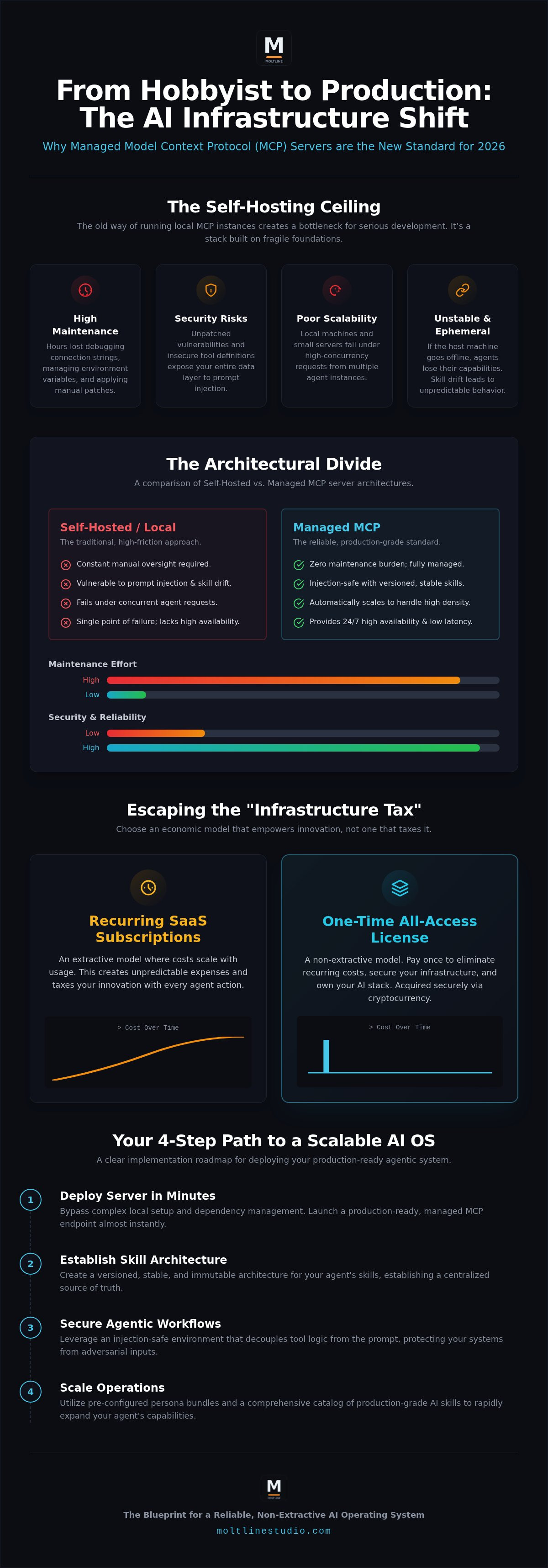
Choosing between self-hosting and managed infrastructure is a decision about where you allocate your engineering capital. Self-hosting an MCP server requires constant vigilance. You are responsible for security patches, dependency updates, and 24/7 monitoring. In a production environment, a single unpatched vulnerability in a tool definition can expose your entire data layer to prompt injection. Getting started with managed MCP servers shifts this operational burden to a specialized provider. This ensures your agents interact with a hardened, monitored environment that scales automatically as request volume increases. Managed infrastructure treats tool-use as a reliable utility rather than a fragile sidecar process.
Scalability is a primary differentiator. A self-hosted server on a local machine or a small VPS will struggle with concurrent requests from multiple agent instances. Managed servers are built to handle the density of modern agentic workflows. For example, enterprise-grade servers now provide access to over 15,000 APIs through a single endpoint. This emerging open standard simplifies the integration of these massive toolsets without requiring you to manage the underlying networking or compute resources.
The True Cost of the Infrastructure Tax
Developer hours are the most expensive resource in any AI project. Every hour spent debugging a local MCP connection is an hour lost on refining agent logic. Unmanaged servers often suffer from skill drift. This happens when tool definitions are updated inconsistently across different environments, leading to unpredictable agent behavior. Managed environments enforce strict version control. They provide immutable skill architectures that ensure your agents perform identically in staging and production. Moltline Studio prioritizes stability by offering tested AI agent skills that have been vetted for performance under adversarial conditions. This eliminates the uncertainty of "it works on my machine" syndrome.
Injection-Safe Architectures for Managed Servers
Managed servers act as a critical firewall between LLM outputs and your system's execution layer. By standardizing tool schemas, these servers prevent common exploits where an agent is tricked into executing unauthorized commands. This is achieved through strict schema validation and sandboxed execution environments. Getting started with managed MCP servers allows you to implement "production AI identities." These identities use managed persona bundles to restrict tool access based on the specific role of the agent. This granular control is difficult to maintain in a self-hosted setup without significant custom development. To secure your production stack, you can browse our managed server configurations available by cryptocurrency payment.
Evaluating the Managed MCP Market: Metered SaaS vs. Flat-Rate Licensing
The AI development ecosystem is reaching a saturation point with recurring subscription models. This "SaaS Fatigue" is a direct result of compounding monthly costs that drain engineering budgets without adding proportional value. Getting started with managed MCP servers requires a strategic choice between metered, credit-based models and flat-rate access. Flat-rate licensing provides a predictable budgeting framework. It removes the per-call metering and credit rationing that plague usage-based tools. One flat monthly fee covers premium tools across all 22 servers, with nothing metered per call.
Predictability and autonomy are the primary advantages of flat-rate licensing. A single key unlocks premium tools across all 22 servers, with no per-call metering and no credit rationing. It removes the usage accounting that can stall an agent mid-run during critical operations. For global AI infrastructure, cryptocurrency payments offer a tactical edge. They provide frictionless, instant transactions that bypass the regional restrictions and delays of fiat systems. This alignment with decentralized protocols mirrors the technical logic of the Model Context Protocol (MCP) itself. It ensures that infrastructure access remains as open and borderless as the code it supports.
Metering-Free AI Infrastructure
The Moltline All-Access License is a flat $19 per month that meters nothing: one key, premium tools on all 22 servers, no per-call billing. Once the cryptocurrency transaction is confirmed, license keys are delivered via instant digital delivery. This speed is vital for developers who need to scale agents immediately. There are no per-call invoices to reconcile and no credits to ration. This model supports long-term stability for production-grade AI agent skills. It auto-renews monthly and you can cancel at any time, at which point the key simply expires at the end of the paid period. You maintain full control over your deployment timeline and cost structure.
Comparing Performance Benchmarks
Managed endpoints significantly outperform local tunnel solutions in high-concurrency environments. Local tunnels often introduce 200-500ms of additional latency. This degrades agent response times and increases token consumption due to timeouts. Production-ready managed servers maintain consistent uptime and lower ping rates. This reliability is non-negotiable for autonomous workflows. Getting started with managed MCP servers ensures that your agents have the low-latency access required for real-time tool execution.
| Feature | SaaS Providers | Self-Hosted | Moltline Managed |
|---|---|---|---|
| Cost Model | Monthly Subscription | Infrastructure + Labor | Flat monthly, unmetered |
| Setup Time | Minutes | Hours to Days | Minutes |
| Maintenance | Provider Managed | Developer Managed | Provider Managed |
| Payment Method | Fiat / Credit Card | Various | Cryptocurrency |
Implementation Roadmap: Deploying Your Managed MCP Server
Deployment begins with intent analysis. Match your managed server architecture to the agent's functional requirements. A research agent requires high-throughput data retrieval; a DevOps agent needs robust system execution tools. Once the intent is defined, secure your production-grade tools via the All-Access License. This grants entry to the full suite of versioned skills. Integration follows. Connect the server endpoint to your LLM of choice, whether it's Claude, GPT-4, or a custom wrapper. The final step involves deploying persona bundles. These ensure identity consistency across distributed sessions. Getting started with managed MCP servers ensures that these steps are repeatable and stable across your entire infrastructure.
When integrating with custom wrappers, focus on header management and secure transport. Ensure that your client-side implementation handles the MCP handshake correctly to maintain persistent connections. This reduces the overhead of repeated authentication cycles. Managed environments simplify this process by providing pre-validated connection strings. You don't have to worry about the underlying networking logic. You only focus on the agent's output quality.
Provisioning Infrastructure with Cryptocurrency
Moltline streamlines infrastructure setup through cryptocurrency. The workflow for purchasing MCP server access with crypto is direct. Select your license. Confirm the transaction. Receive your digital key instantly. This speed is critical for production engineering. Managing license keys effectively involves environment-specific configuration. Use secure vault systems to inject your All-Access License keys into your CI/CD pipelines. This prevents hard-coding and maintains security across the development lifecycle. Immediate deployment is guaranteed upon transaction confirmation. This removes the 24-48 hour wait common with traditional banking systems. It allows for rapid iteration without administrative delays.
Configuring Agentic Workflows
Connecting the managed MCP server to your agentic logic framework requires precise mapping. Tool definitions must align with specific agent personas to prevent logic overlap. Use standardized JSON-RPC calls to ensure the model understands the tool's schema without ambiguity. Test every tool for injection safety and output reliability before moving to full deployment. Getting started with managed MCP servers allows you to conduct this adversarial testing in a controlled environment. This ensures the agent doesn't overstep its functional boundaries. It protects your system from unintended execution and maintains the integrity of your data. You can access our full catalog of MCP servers to begin your deployment today.
Scaling with Moltline: The All-Access Production Stack
The Moltline ecosystem is built on the synergy between infrastructure and identity. Scaling a production-grade agent requires a unified stack where tools, skills, and personas operate in lockstep. Getting started with managed MCP servers provides the necessary connectivity. Persona bundles provide the behavioral constraints. This combination ensures that your agents don't just have access to data; they have a consistent professional identity that dictates how they use it. The Moltline catalog offers specialized AI agent skills that are pre-validated for these managed environments. These skills cover diverse industry use cases, from automated DevOps pipelines to complex financial data synthesis. Centralizing these capabilities within a managed server ensures that every agent in your fleet operates with the same high-standard logic frameworks.
Long-term stability is achieved through versioned infrastructure. Unlike unmanaged setups where dependency updates can break tool definitions, managed environments provide a frozen, tested state for your production skills. This reliability is coupled with the financial predictability of a flat monthly rate. You aren't metered per call or rationed by credits; one key covers premium tools across all 22 servers for a single flat fee. This allows for aggressive scaling without the fear of compounding overhead or vendor lock-in.
Persona Bundles and Identity Management
Production agents need more than a simple system prompt. Prompts are fragile. They are easily bypassed or diluted by long conversation histories. Persona bundles offer a structural solution by standardizing AI identities across engineering and operational teams. These bundles integrate directly into the MCP server context. This ensures that every tool call is filtered through the agent's specific role and authorization level. It creates a robust layer of identity management. This is essential for collaborative environments where multiple agents interact with shared resources. You establish a clear chain of command and functional boundaries for every autonomous unit.
Beyond the Prompt: Your 2026 Production Strategy
The transition from experimental prompts to professional infrastructure is the defining shift of 2026. A resilient stack must be immune to the volatility of SaaS pricing and the fragility of local hosting. Moltline’s All-Access model provides this stability. By utilizing versioned infrastructure and flat-rate access, you secure your technology stack against per-call cost volatility. Getting started with managed MCP servers ensures that your deployment is ready for adversarial conditions and high-concurrency demands. This is not about building a chatbot. It's about deploying a functional, scalable AI infrastructure that respects your budget and your data. Managed MCP servers are the foundation of this evolution. They turn autonomous software agents into reliable workforce components.
Secure your All-Access License and start deploying managed MCP servers today.
Building Resilient Agentic Infrastructure
The move from local testing to production requires a rigorous commitment to stability. Managed MCP servers provide the injection-safe, versioned environment that autonomous agents need to function reliably. By choosing a flat-rate licensing model over credit-metered subscriptions, you secure predictable costs for your engineering team. This approach eliminates the maintenance tax of self-hosting and the financial uncertainty of SaaS. Getting started with managed MCP servers is the most efficient path to deploying professional AI agents that respect your data and your budget.
Moltline Studio delivers this stability via an All-Access License. You get digital license keys delivered instantly, in cryptocurrency, providing flat-rate monthly access to a catalog of production-grade AI agent skills. This isn't about chasing the next hype cycle; it's about establishing a grounded, professional infrastructure that performs under pressure. Get Started with an All-Access License today and stabilize your production stack. Your agents are ready to scale.
Frequently Asked Questions
What is the difference between a managed MCP server and a standard API?
A managed MCP server is a stateful, protocol-driven interface that enables dynamic tool discovery, whereas a standard API is typically a stateless endpoint requiring manual integration for every function. Managed servers handle the JSON-RPC handshake and schema validation internally. This reduces the complexity of getting started with managed MCP servers by providing a unified environment where LLMs can query available capabilities without custom glue code for every external tool.
How do I purchase a managed MCP server license with cryptocurrency?
Purchasing an All-Access License is a streamlined process paid in cryptocurrency through NOWPayments, billed at a flat $19 per month. You select your license tier, generate a payment address, and transfer the required assets. Because we avoid fiat systems, there are no banking delays or regional restrictions. Digital license keys are delivered via instant digital delivery once the transaction is confirmed on the blockchain. This ensures you can provision your production infrastructure in minutes.
Are managed MCP servers safer than self-hosted options for production?
Managed servers are significantly safer for production because they implement injection-safe architectures that are difficult to maintain in self-hosted environments. They provide a hardened execution layer that validates every tool call against strict schemas. This prevents adversarial prompts from executing unauthorized system commands. By decoupling the tool logic from the model's direct output, managed servers act as a critical security firewall for your agentic workflows.
Can I use Moltline managed servers with Anthropic Claude and OpenAI GPT-4?
Yes, Moltline managed servers are fully compatible with Anthropic Claude, OpenAI GPT-4, and other major LLMs. The Model Context Protocol is an open standard designed for model-agnostic tool use. Whether you are using Claude's native MCP support or wrapping GPT-4 in a custom agentic framework, our servers provide a consistent interface. This versatility is a core benefit when getting started with managed MCP servers for multi-model deployments.
What happens if the protocol (MCP) is updated? Do I need a new license?
No, you do not need a new license when the protocol is updated. Our managed infrastructure handles all underlying versioning and compatibility logic for Anthropic and Claude protocol updates. Your active All-Access License covers the server environment at the same flat monthly rate, including all necessary maintenance to keep your tools functional as the standard evolves. This ensures long-term stability for your production agents without version surcharges or manual patching.
Is there a free tier available for testing managed MCP skills?
We provide Free Tier Tools specifically for developers who need to validate the protocol before moving to production. These tools allow you to test the connectivity and basic skill execution within your local or staging environments. Once you've confirmed that the architecture meets your requirements, you can upgrade to an All-Access License to unlock the full catalog of production-grade AI agent skills and managed server features.
How do I integrate persona bundles with my managed MCP server?
Persona bundles are integrated directly into the MCP server context to define the behavioral identity of your agent. During the handshake process, the server identifies the agent's persona and restricts tool access based on predefined operational boundaries. This ensures that a DevOps persona only accesses infrastructure tools while a Research persona is limited to data retrieval. This identity management is essential for maintaining consistency across distributed agent sessions.
Why does Moltline use a flat monthly rate instead of per-call billing?
We utilize a flat-rate license at $19 per month, billed monthly, to eliminate per-call metering and provide predictable engineering budgets. It auto-renews and you can cancel at any time, at which point the key expires at the end of the paid period. Credit-based SaaS pricing forces teams to ration agent calls and compounds costs that often outpace the value of the tool. A flat monthly fee lets your agents use premium tools across all 22 servers without counting credits. This aligns with our commitment to professional transparency and long-term stability for engineering-first teams.