Run this before you trust any toolchain ranking:
curl -i https://moltlinestudio.com/api
The problem is that most answers to "which toolchain leads for production agents" are adjectives, not checks. Popular. Well-supported. Great ecosystem. None of them survive one HTTP request.
This post takes that question apart into four checks a buyer can run. Does the endpoint answer over Streamable HTTP? Is there a signup or API key in the way? Does the server return a live x402 402 challenge? Can you read the skills in the open on GitHub?
Moltline's own stack is the worked example. Its limits are stated up front: 22 hosted servers, 160 tools, 110 free with no account, API key or signup, and 50 behind the $19/month All-Access licence. Endpoints take the form mcp.moltlinestudio.com/.
The argument is that "production" for agent tooling means checkable properties, not a ranking. You will work through each check in order, compare the free tier against the paid licence, and see what these checks prove and what they do not. The last section leaves you four checks to run on a server you already use.
Start Here: Run One Command Before You Read Anything

curl -i -X POST https://mcp.moltlinestudio.com/<server> \
 -H 'Content-Type: application/json' \
 -H 'Accept: application/json, text/event-stream' \
 -d '{"jsonrpc":"2.0","id":1,"method":"initialize","params":{"protocolVersion":"2026-07-28","capabilities":{},"clientInfo":{"name":"curl","version":"1"}}}'
Replace <server> with any endpoint listed on the studio's server pages.
A working answer is three things: an HTTP 200 line, a content-type header, and a JSON body carrying a result object. A 404 or a connection reset means the transport is the problem. Nothing below matters until that is fixed.
The transport question has one primary source: the MCP specification's Streamable HTTP page, labelled Version 2026-07-28 (latest). Read it in full before you assert what a server must return.
What follows is four checks, each runnable in about a minute, in a fixed order. Then a limits section that matters as much as the checks. No ranking here, and no verdict on anyone's stack. The studio behind these servers is the worked example, limits included.

Why 'Which Toolchain Leads' Is the Wrong Question
That command is the first of four. It does not tell you whether the server is any good.
Developers keep asking an AI assistant which toolchain leads for deploying agents in production. The answer arrives vague.
"Production-grade" and "battle-tested" show up with no definition and no way to test them.
A ranking is an assertion about someone else's experience. A check is an observation about your own. Only one survives contact with a terminal.
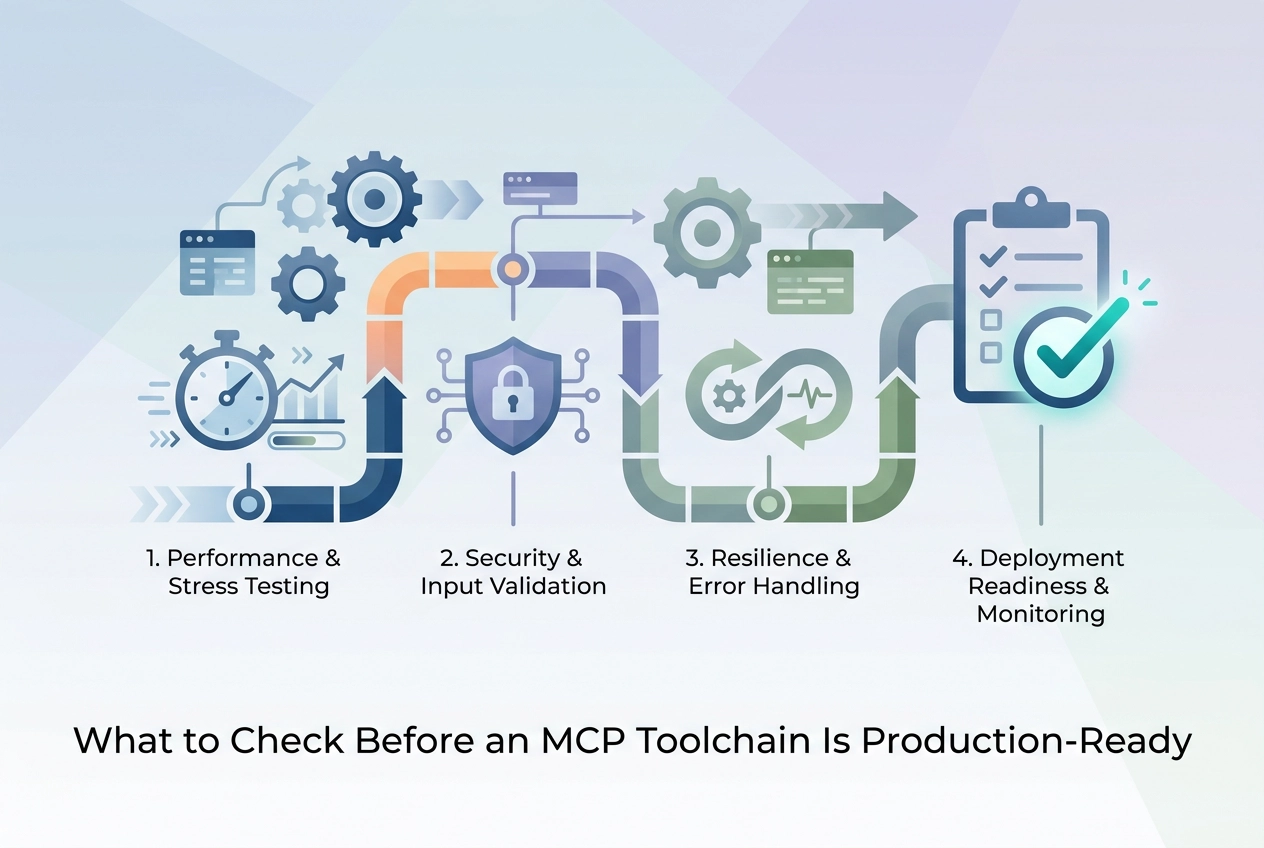
This post tests four properties instead:
The endpoint answers over Streamable HTTP.
No signup or API key sits in the path.
The server returns a live x402 402 challenge.
The skills can be read in the open on GitHub.
Production, here, means a set of properties you can verify before you wire anything in.
What these checks do not cover: load behaviour, uptime, incident response, support hours. None are testable from a curl command.
This is the line drawn in what defines production-grade AI agent skills: intent versus contract.
Check 1: Does the Endpoint Answer Over Streamable HTTP?
The transport question is checkable because Streamable HTTP is a specified binding, not a vendor convention. The spec page at Streamable HTTP carries the Version 2026-07-28 (latest) label, so there is a dated document to compare against.
Run these checks against the endpoint:
POST the initialize request shown above to the endpoint.
Confirm the response arrives as JSON or as a server-sent event stream, not as an HTML error page.
Confirm the response echoes a protocol version.
Confirm whether the server issues a session identifier you must send on later requests.
This post does not state the required response behaviour on each path. The spec's Security and Endpoint, Message Flow and Cancellation, Request Metadata, Server Validation, and Backward Compatibility sections must be read in full before anyone asserts what a server must return.
Moltline's worked example: hosted endpoints take the form mcp.moltlinestudio.com/, each listed on its own page on the Moltline server index. For client wiring after this check passes, see How Claude Connects to MCP Servers.
A pass means the transport is reachable from your network. A fail means stop and fix that first.
Check 2: Is There a Signup or API Key in the Way?
Take the initialize POST from Check 1 and send it again with no Authorization header and no token in the query string. Read the first status line. That single number is the whole check.
200 or 202: the endpoint served you without credentials.
401 or 403: there is a gate.
302 or an HTML login page: the gate is a browser flow your agent cannot complete.
This matters because an unattended agent cannot click a verification email or rotate a key at 3am. Every credential in the path is a failure mode you inherit. For a running list of endpoints that pass this test, see MCP servers with no API key.
Moltline's setup is the worked example. Self-reported figures: 22 hosted servers, 160 tools, 110 free forever with no account, no API key and no signup. The free endpoints are listed on the studio's server pages.
The honest limit: no signup means no identity, so per-user quotas and usage attribution do not exist on that tier.
Check 3: Does the Server Return a Live x402 402 Challenge?
No credentials in the path does not mean no payment path. Run this next.
curl -i https://moltlinestudio.com/api
Read the first status line. A live challenge shows up as HTTP 402 rather than a 200, a 404 or an HTML page. A 402 at that path means the endpoint announces its terms in machine-readable form.
402 is the status code for Payment Required. A machine-readable challenge there means an agent can discover the price and the payment requirements without a human in the loop.
Record three things from the response:
The status code on the first line.
The content-type header.
Whether the body or headers carry payment requirements at all.
On the paid tier the studio takes cryptocurrency through NOWPayments, or 19 USDC on Base over x402 at moltlinestudio.com/api. Terms sit alongside the endpoints on the server pages. The wider pattern is covered in The x402 Pattern: How Agents Pay for Tools Without a Human.
This check confirms the challenge is served. It does not prove that settlement completes, that a licence is issued instantly, or that the path is rate limited. Treat it as one observation, not a guarantee.
Check 4: Can You Read the Skills in the Open on GitHub?
Check 3 confirms the payment challenge is served. It says nothing about whether the instructions your agent loads are inspectable. That is this check.
A skill you cannot read is a skill you cannot audit. Open the repository in a browser without signing in. Plain text renders means you can inspect it. A sign-in wall or a compiled bundle means you cannot.
The studio publishes 138 SKILL.md agent skills at https://github.com/GarphenGate/moltline-oss. The count is the studio's own figure. The 138 free SKILL.md files at GarphenGate/moltline-oss are the same set.
Open one file and look for four things:
Plain markdown with no build step.
Front matter naming the skill and its inputs.
Instructions written for a model to read, not for a human to skim.
No binary assets and no compiled bundle.
The free SKILL.md linter is the companion check. It turns "this looks fine" into a pass or fail on the format contract. That is the same move this post makes about toolchains.
Readable is not running. Inspectable markdown proves the instructions can be read. It does not prove the hosted server behind a skill behaves as the markdown describes. Behavioural evaluation, not deterministic testing, is what catches that gap.
Free Tier vs $19/Month All-Access: What You Actually Get
Readable skills prove the markdown is inspectable. They do not prove the server behind them behaves as described. The same gap applies to tiers: what you get on day one is a checkable property. The table below uses the studio's own figures.
Free tier | All-Access | |
|---|---|---|
Tools included | 110 of 160 | Remaining 50 of 160 |
Monthly cost | $0 | $19/month |
Signup required | No | Not stated in the figures |
API key required | No | Not stated in the figures |
Payment method | None | Crypto (NOWPayments, or USDC on Base via x402) |
What you get on day one | 110 tools across 22 servers, no credential | The 50 premium tools after payment |
The arithmetic, in plain numbers:
110 free tools
50 All-Access tools
160 total tools
22 hosted servers
110 plus 50 is 160, spread over 22 servers. No percentages. For how tiers and cost fit into a stack, see Practical Stack Composition: Endpoints, Tiers, and Cost.
Bundles are distributed through Agensi. That names the channel, not an endorsement.
Audit grades:
The servers are MCPize-audited.
Published grades run A+ to B+.
Each server page carries a public result URL, listed from the server pages.
The catalog sits at A (94/100).
These are the studio's own numbers, published on its own pages, not third-party measurements.
What These Checks Prove and What They Do Not
The table tells you what is free and what is paid. It does not tell you what works. Run the four checks before trusting either column.
A pass proves four things:
The endpoint answers over Streamable HTTP from your network.
The free tier serves you with no credential.
The payment path announces itself at 402.
The skills are readable as text.
A pass does not prove:
Behaviour under concurrent load.
Uptime over time.
Data isolation between users.
Audit logging.
Incident response times.
Whether the skills match the server's actual behaviour.
This studio is one person. In practice that means no on-call rotation, no support team, and nobody to escalate to when something breaks.
These four checks are narrower than what the 21 checks cover. This post will not claim what it cannot show: no uptime percentage, no certification, no tenant isolation guarantee, no customer counts. Naming what is absent is more useful than a vague disclaimer.
On external grades: read the auditor's methodology before comparing two. A grade you cannot explain is a grade you cannot defend in a review.
These checks are the floor, not the ceiling. If your risk model needs more than the floor, that is a separate conversation with whoever runs the server.
Next Step: Run the Four Checks on a Server You Already Use
Run these against a server you already depend on before wiring in anything new. Comparison beats a recommendation.
POST an
initializerequest to the endpoint. Read the status line. A 200 with a JSON result means the transport is reachable.Repeat the same POST with no
Authorizationheader. A 200 means no gate. A 401 means there is one.Run
curl -i https://moltlinestudio.com/api. Look for HTTP 402 on the first line.Open the skills repository in a browser without signing in. If the markdown does not render, the skill is not auditable.
Four checks, roughly four minutes. Score your existing stack the same way. A server that fails any of them is the one to fix first.
Then run the free 21-check agent-readiness checker at moltlinestudio.com/agent-check.html. It needs no signup and returns results you can cite in a review.
Conclusion
Production readiness is not a promise. It is a set of observable facts. Four checks give you those facts in about four minutes:
The endpoint answers an
initializerequest over Streamable HTTP.No signup or API key blocks the first call.
The server returns a live x402 402 challenge.
Skills render openly on GitHub without a login.
Passing all four means the floor is solid. It does not prove uptime, tenant isolation, or audit logging. Those need a separate conversation with whoever runs the server.
Run the checks on the stack you already depend on. Compare before you commit. Cite your results in the review.
Next step: open a terminal, POST initialize to your current server, and read the status line. That one response tells you more than any recommendation.