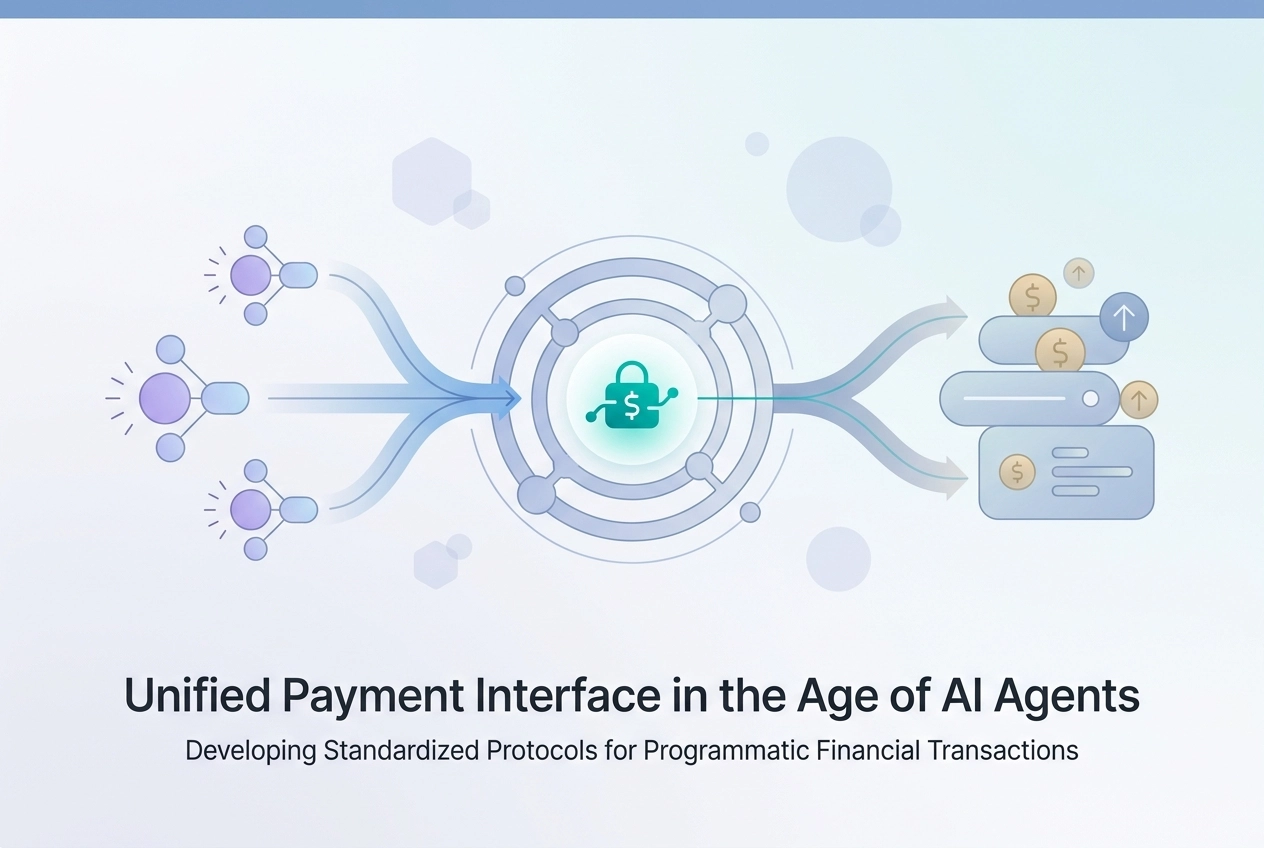
When an AI agent books your flight, orders your groceries, and pays your utility bills without a single manual input, the payment layer powering those transactions becomes mission-critical infrastructure. This is no longer a distant scenario. Autonomous AI agents are already operating within real-world financial workflows, and they need a reliable, standardized mechanism to exchange value programmatically.
This is where the unified payment interface becomes a foundational piece of the puzzle. Originally designed to simplify peer-to-peer and merchant transactions through interoperable rails, UPI is now facing an entirely new class of participants: non-human actors making high-frequency, context-driven payment decisions.
In this analysis, we will explore how the unified payment interface architecture is being stress-tested and reimagined for AI agent compatibility. You will gain a technical understanding of the current protocol limitations, the emerging design patterns being proposed to address them, and what authentication, authorization, and transaction semantics must evolve to support machine-driven financial interactions. If you work in fintech, AI infrastructure, or payment systems, this is a convergence point you cannot afford to overlook.
Two Definitions, One Keyword
The phrase "unified payment interface" resolves to two distinct technical realities, and in 2026, they are no longer separate conversations.
Definition one is a proper noun. UPI, the Unified Payments Interface, is India's national real-time payment rail operated by the National Payments Corporation of India (NPCI). It routes bank-to-bank transfers identified by Virtual Payment Addresses (VPAs) at national scale, and was built with one assumption baked into every layer: a human being approves each transaction via MPIN authentication. It is specific national infrastructure, not a generic architectural pattern.
Definition two is an architectural concept. In developer and agent tooling contexts, "unified payment interface" describes a single programmatic layer through which an AI agent can discover what something costs, authorize payment, and settle, regardless of which rail, currency, or counterparty sits underneath. The concrete implementations of this concept include x402 (HTTP 402 as a machine-readable payment signal inside MCP tool calls), ACP, UCP, AP2, and network overlays from card schemes. None of these are UPI. They are protocol abstractions sitting above settlement infrastructure.
The ambiguity has now collapsed. Pine Labs launched P3P, the Pine Labs Payment Protocol, described as India's first agentic payment protocol built directly on UPI rails. P3P uses UPI's existing One Time Mandate and Single Block Multiple Debit frameworks to let an agent transact within pre-authorized spending limits, with no per-transaction human approval. It stacks HTTP 402 on top of UPI settlement, making definition one the substrate and definition two the interface. The two definitions now share one live implementation.
This piece covers both. It examines UPI-the-rail, how P3P extends it into agentic commerce, and what a unified payment interface looks like as a broader protocol concept across the agentic payments standards landscape, including x402 and MCP-native tooling.
If you arrived here from an MCP or agent tooling context, skim the UPI rail section and go straight to the x402 and protocol sections. If you come from a payments background, read sequentially; the protocol sections assume familiarity with concepts introduced earlier.
What UPI Actually Is: The Rail Underneath P3P
Unified Payments Interface is a real-time payment system built by the National Payments Corporation of India (NPCI). It routes transactions between bank accounts using a Virtual Payment Address (VPA), formatted as name@bankname, so neither sender nor receiver needs to exchange account numbers or IFSC codes. The VPA maps to the underlying bank account; NPCI's switch handles the routing. It runs on top of India's Immediate Payment Service (IMPS) infrastructure, which provides the interbank messaging layer underneath.
The Two Primitives That Matter for Agents
Two UPI mandate primitives are directly relevant to autonomous payment flows, and they arrived five years apart.
One Time Mandate (OTM), shipped with UPI 2.0 in August 2018, authorizes a single future debit. The payer approves the payment now; execution happens later, with no fresh OTP or biometric required at execution time. Single Block Multiple Debit (SBMD), announced by the RBI in December 2022 and enabled by NPCI circular in 2024 under the consumer-facing name UPI Reserve Pay, extends that model further. The payer pre-authorizes a block of funds with a defined cap. An agent can then debit against that block multiple times, autonomously, until the cap is reached. No per-transaction confirmation. No interrupt.
Both primitives do the same structural thing: they decouple authorization from execution. The human sets a spending boundary once. The agent operates freely within it. This is precisely the model that agentic payment layers need, regardless of which rail they run on. Pine Labs P3P is built directly on these two UPI primitives. Gullak is the first live implementation.
Settlement Speed and the Bank-Rail Ceiling
UPI's settlement is near-real-time. That is fast for a system built on interbank messaging infrastructure. However, it is slower than stablecoin settlement on chains such as Polygon PoS or Base. The difference is architectural. Bank rails carry interbank messaging overhead and settlement finality requirements that blockchain-based rails do not. This is not a UPI-specific limitation; any IMPS-based system carries the same ceiling.
Geographic Scope and the Transferable Pattern
UPI is Indian infrastructure, though no longer India-only: as of February 2026 it is accepted in more than eight countries including the UAE, Singapore, Bhutan, Nepal, Sri Lanka, France, Mauritius and Qatar, with NPCI International signing deployment deals across roughly twenty-five markets. What has not changed is the origination side. To initiate on the rail you still need a relationship with a participating Indian bank or payment service provider, so developers outside India cannot connect directly.
That said, the design pattern is fully portable. Pre-authorized spending envelopes plus machine-readable payment signals work on any payment stack. A Stripe subscription with a spending cap, a USDC allowance on an EVM chain, or an ACH preauthorization with a defined limit all implement the same architecture: authorize once, execute many times within the boundary, no human in the loop per transaction. UPI made this pattern concrete and production-tested at scale. P3P applied it to agents. The pattern itself belongs to no single rail.
Pine Labs P3P: Where UPI Meets HTTP 402
Pine Labs launched P3P, the Pine Labs Payments Protocol for AI Agents, an agentic payment protocol built directly on UPI rails. The problem it solves is precise: every standard UPI transaction requires a human to enter an MPIN at the moment of payment. That single requirement breaks any autonomous agent workflow entirely. P3P eliminates that requirement by shifting authorization to a pre-approved mandate stage, letting the agent execute within a pre-defined spending envelope without interrupting the user for per-transaction confirmation. Gullak, India's digital gold savings platform, is the first live commercial deployment. A user sets a conditional rule, such as buying a fixed amount of gold whenever the price falls below a chosen threshold, approves a UPI mandate once, and the agent executes when the condition is met. The user receives a confirmation, not a permission request.
Three Layers, One Protocol
P3P is a three-layer architecture. Understanding each layer is more useful than treating P3P as a single opaque product.
Layer 1: UPI mandate frameworks (SBMD and OTM). P3P extends UPI's One Time Mandate (OTM) and Single Block Multiple Debit (SBMD) capabilities. OTM is a pre-authorization mechanism where a user approves a payment instruction in advance; the debit executes later without re-authentication. SBMD extends that concept to allow multiple debits against a single blocked amount. P3P maps agent-triggered payments onto these existing primitives rather than introducing a new debit mechanism at the transaction level.
Layer 2: HTTP 402 for machine-readable payment signaling. This is the signaling layer. When an agent hits a P3P-enabled endpoint without valid payment context, the server returns an HTTP 402 status with a machine-readable payload describing what is required. Pine Labs uses HTTP 402 as an open web standard for machine-readable payment requests, but the challenge is P3P-specific: the 402 arrives in a WWW-Authenticate header and is answered with a P3P-Credential derived from a Grantex JWT, not with the JSON accepts body and X-PAYMENT header that x402 uses. The signaling layer is rail-agnostic by design: the 402 response describes a payment requirement; the underlying settlement mechanism is a separate concern. Reusing the HTTP status code rather than inventing a bespoke one keeps the signalling legible to any HTTP client, but P3P and x402 are not wire-compatible today, and Pine Labs makes no interoperability claim between them.
Layer 3: Grantex for agent identity. Grantex is the identity and authorization layer. It addresses what the industry is starting to call the KYA (Know Your Agent) problem. Standard fraud detection relies on behavioral biometrics, device fingerprinting, and human identity signals that AI agents do not produce. An IP address is not an agent identity. Grantex requires that any agent spending within a pre-authorized envelope be authenticated as a known, verifiable agent identity before the transaction proceeds. It also provides spend controls, delegated authorization scopes, and an audit trail. Users can revoke or update the mandate.
The Design Pattern Generalizes
Pine Labs describes P3P as India-specific in its rail, but the architecture is not India-specific in its logic. The three-layer pattern, pre-authorization primitives, HTTP 402 for machine-readable signaling, and an agent identity layer, maps onto any national real-time payment network. FedNow in the United States, PIX in Brazil, and Faster Payments in the UK are the obvious places to look for a Layer 1 analog. The HTTP 402 layer is already rail-agnostic. The gap in each case is Layer 3: a KYA-capable identity layer that can issue and verify agent credentials, enforce spend limits, and produce tamper-evident audit logs. P3P is instructive precisely because it treats that identity layer as a first-class protocol component rather than an afterthought bolted onto existing account infrastructure.
For developers building agent workflows outside India, P3P is worth studying as a reference architecture. The core question it answers, how do you let an agent pay autonomously while preserving auditability and revocability, is not a question unique to UPI.
How HTTP 402 Works Inside an MCP Tool Call
HTTP 402 "Payment Required" has existed in the HTTP specification since RFC 2068, part of HTTP/1.1. For most of the web's history, it sat unused. The code was a placeholder; the spec reserved it but never defined what a payment-required response should actually contain. Browsers and servers had no agreed structure for the body, no standard headers, no defined retry behavior. The status code existed in theory and did nothing in practice.
x402 is the convention that finally gives 402 concrete semantics. Originally built by Coinbase and open-sourced, it defines exactly what a 402 response body must contain, how a client constructs and submits a payment, and how the server verifies proof before returning the resource. It is developed in the open rather than as a single vendor's product.
The Request-Pay-Retry Cycle
The flow inside an MCP tool call has four steps. First, an MCP client (Claude Desktop, Cursor, or a custom agent runtime) calls a tool on a server using a normal HTTP request. Second, if that tool has a cost, the server returns HTTP 402. The response body is a structured JSON payload containing the payment details: x402Version, an accepts array that specifies scheme, network, maxAmountRequired, payTo (the seller wallet address), asset (the token contract address), resource URL, and maxTimeoutSeconds. Third, the client resolves the payment on-chain, signing a USDC transfer to the specified address. Fourth, the client retries the original request with an X-PAYMENT header containing the signed payment proof. The server verifies the on-chain payment, then returns the resource.
The entire cycle carries cryptographic finality. No session state lives on the server between the initial 402 and the retry. The server does not track the client identity; it only checks whether the payment proof is valid.
What the Payload Actually Looks Like
A minimal x402 response body is JSON, not a single header. The accepts array entry specifies the network (for example, base or base-sepolia), the maximum amount required, the destination wallet, and the USDC token contract. A nonce or maxTimeoutSeconds field prevents replay. The client reads this, constructs a signed EIP-712 authorization or equivalent, and retries. The X-PAYMENT header on the retry carries that signed proof. Servers can verify locally or delegate verification to a facilitator service.
Why This Removes the Onboarding Funnel
Conventional API access requires creating an account, completing KYC, adding a payment method, purchasing credits or starting a subscription, generating API keys, and then making authenticated requests. Every step assumes a human is present to complete a form. x402 removes all of those steps structurally. An agent can discover that a tool costs money from the 402 response itself, pay for it on-chain from its own wallet, and retry, with no human approval step and no pre-registered billing relationship between the agent operator and the tool server.
This is not a minor convenience improvement. It is the difference between a tool an agent can use autonomously and a tool that requires a human to set up billing before any agent can touch it.
A Live Example: Moltline Studio's 402 Challenge
Moltline Studio's MCP servers demonstrate a two-endpoint version of this pattern in production, and the split is worth understanding because it is the shape most MCP servers will end up with. Paste any of the 22 hosted MCP server URLs, listed at mcp.moltlinestudio.com, into an MCP client. The 110 free tools respond directly with no credentials required. Call one of the 50 premium tools without a licence and the tool call itself returns HTTP 200 with a machine-readable refusal body, not a 402 — the MCP transport is carrying the JSON-RPC result, so the HTTP status stays 200 by design. That refusal names the tool, the price (USD 19.00 per month), a human checkout URL, and an x402 object pointing at the resource that does speak 402.
That resource is https://moltlinestudio.com/api. Request it and it returns a real HTTP 402 with the demand in both the body and the response headers: accepts carrying scheme exact, network eip155:8453 (Base), asset USDC, and amount 19000000 — six decimals, so USD 19.00. Retry with the transaction hash in the X-PAYMENT header and the licence key comes back in the response. No signup, no API key, no billing form exists anywhere in that flow, and a human operator never touches it.
The distinction matters if you are copying the pattern: the 402 settles a month of access, not a single call. An agent that wants one premium call still buys the month. Per-call metering over x402 is a different design, and this is not it.
Ecosystem and Protocol Choice
x402 is not a proprietary spec, and multiple independent implementations exist. That breadth matters when you are choosing infrastructure: the payment signal your server emits will be readable by any conforming client, regardless of which runtime the agent operator uses. It is worth weighing x402 against MPP, the Machine Payments Protocol co-authored by Stripe and Tempo, before committing. The two have converged more than the headlines suggest. Both use a 402 challenge and retry, both now reach beyond crypto, and both support session-style pay-as-you-go billing. The live differences are settlement network and accounting: MPP routes card and stablecoin payments through Stripe's existing tax, refund and reporting tooling, while x402 keeps settlement on-chain by default. Which model fits depends on your tool's pricing granularity and your tolerance for per-call settlement overhead.
The 2026 Protocol Landscape: x402 Is Not the Only Option
Several distinct agentic payment protocols are in active deployment. The roster includes x402, ACP (the Agentic Commerce Protocol, created jointly by Stripe, OpenAI and Meta), Google's UCP, Google's AP2, Nevermined, Mastercard Agent Pay, and Visa's Trusted Agent Protocol, with further entries such as L402, Amex ACE, and MPP alongside them. The race is active, not settled.
MCP Is the Stable Layer
These protocols do not share a substrate. ACP is an OpenAPI-and-webhooks standard created by Stripe, OpenAI and Meta; Visa's TAP operates agent-to-merchant over HTTP; Mastercard Agent Pay runs on card rails via Agentic Tokens; AP2 is designed to be used as an extension of A2A or MCP. MCP is the layer your tool-calling logic sits on, not a layer all of them inherit. Anthropic open-sourced the Model Context Protocol, and it has since been donated to the Linux Foundation's Agentic AI Foundation, co-founded with Block and OpenAI. By then the spec already had a large public server ecosystem and heavy SDK adoption across Python and TypeScript. Recent MCP spec revisions added async Tasks in 2025-11-25 and a stateless-first core in the 2026-07-28 release candidate, both directly relevant to autonomous agent billing scenarios where no human is in the loop. Server identity is still being designed as a Server Card proposal in a dedicated working group, not yet shipped.
The governance move to a neutral foundation matters. It reduces single-vendor lock-in risk for the base layer. MCP is a safe long-term dependency in a way that no individual payment signaling protocol above it currently is.
The Payment Layer Is Not Stable
Choosing x402 today means betting on a specific signaling convention, not on MCP itself. x402 has already shipped a second major version and the spec is still moving. Google's UCP and AP2 both arrived recently, AP2 with a broad set of partner organizations. MPP, co-developed by Stripe and Tempo, introduced a sessions model for pre-authorized spending limits with both stablecoin and fiat settlement.
The practical hedging strategy is straightforward: build your tool-calling logic against MCP. Keep the payment handler modular and swappable. Nevermined's architecture is the clearest public example of this approach, with native support for x402, MCP, A2A, and AP2 as composable layers. Compare MPP, ACP, AP2, and x402 directly against your own requirements before committing to any single path.
Card Networks Are Not Developer Tooling
Mastercard Agent Pay and Visa Trusted Agent Protocol belong in a separate mental bucket. They are consumer-facing and institutional-merchant-facing overlays, not infrastructure for wiring agents to call and pay for MCP tools. Mastercard began with a limited cardholder rollout before widening it. Visa's TAP is designed to reach the card credentials and merchant locations already on Visa's network, and Visa expects consumers to use AI agents for purchases at scale.
None of that is relevant if you are building an agent that needs to autonomously call a paid MCP tool endpoint. For that use case, x402 or Nevermined's full stack are the options worth evaluating.
ACP Is Merchant Checkout, Not Tool Payment
The Agentic Commerce Protocol, created by Stripe, OpenAI and Meta, is in production: Coach, Kate Spade and URBN went live on Stripe's Agentic Commerce Suite in December 2025, and Etsy was a launch merchant for ChatGPT's Instant Checkout. It handles checkout flows between AI agents and retail merchants. It originated from ChatGPT's Instant Checkout, which OpenAI has since scaled back: after only about a dozen Shopify merchants went live, OpenAI said Instant Checkout is "moving to Apps," and purchases now flow through retailer apps such as Instacart, Target and Expedia. PayPal became the first wallet inside ChatGPT in October 2025. It is not infrastructure for monetizing API endpoints or MCP tools at the machine-to-machine layer.
Mapping which layer each protocol actually occupies is the useful exercise here. Conflating ACP with x402-style tool payment leads to the wrong architectural decisions. They solve different problems at different points in the stack.
The summary: MCP is stable infrastructure. The payment signaling layer above it is a live standards competition. Design your agent stack with that boundary in mind.
Crypto, Stablecoin, or Fiat: What to Wire to an Agent Wallet
USDC on Base has emerged as the default settlement layer for agent wallets in 2026: USDC accounts for over 99.99% of agentic transfer volume on x402, and more than 90% of the protocol's 160 million cumulative transactions have settled on Base. The pattern is consistent across agentic payment infrastructure: USDC is the primary settlement token, and settlement is fast relative to bank rails. Stablecoin volume and float have both grown substantially. This is not a niche experiment. It is the production baseline.
Why Fiat Rails Fail Structurally
Fiat payment infrastructure was designed around a human identity layer that agents cannot satisfy. Fraud detection models rely on behavioral biometrics: typing cadence, mouse movement, device fingerprints. An agent produces none of these signals, so it looks fraudulent by default. Beyond identity, every card network and bank transfer requires a registered account tied to a legal person. An AI agent has no passport and cannot open a bank account. Credit card processing carries a percentage fee plus a fixed per-transaction charge, so a tool-call micropayment can cost more to process than the payment itself. ACH settles in business days, not seconds. Wire transfers operate only during banking hours. Neither is compatible with sub-second agent workflows.
UPI is the closest fiat-adjacent rail to agent-compatible latency. India's Unified Payments Interface settles in real time and has the pre-authorization primitives, Single Block Multiple Debit and One Time Mandate, that P3P builds on. But even UPI requires the P3P wrapper to operate without per-transaction human approval. Without that layer, a human must confirm each payment. For autonomous agents running at machine speed, that is a blocking dependency.
The Volatility Problem with Non-Stablecoin Crypto
Crypto wallets solve the identity and speed problems. They do not require KYC tied to a human, they support micropayments, and on-chain finality is measured in seconds. The problem with non-stablecoin assets is that the payment unit itself fluctuates. If an agent is authorized to spend a fixed dollar amount and the underlying asset falls sharply mid-session, the actual fiat-denominated spending envelope shrinks without any instruction from the developer. USDC eliminates this by maintaining dollar parity while preserving all the programmability and low-fee characteristics that agent transactions require. A deterministic per-request price is only reliable when the payment unit itself is stable.
Moltline Studio's All-Access licence runs at $19 a month, billed monthly through NOWPayments and payable in cryptocurrency, cancellable at any time. An agent does not have to visit that checkout page: the same $19 is settleable machine-to-machine at https://moltlinestudio.com/api, which serves a live HTTP 402 carrying an x402 demand for 19000000 units of USDC on Base. The agent reads the terms out of the 402 and resolves them autonomously, with no human in the loop. What it buys is the same month of access a human would buy — the 402 is an alternative counter, not a per-call meter.
The Practical Recommendation
For developers wiring an agent wallet today, USDC on Base is the lowest-friction path. Base has low gas fees, fast finality, and broad support across x402 implementations. Polygon PoS is a viable alternative with comparable settlement characteristics. Layering wallet, onramp, and orchestration together is the remaining integration work.
Stripe's acquisition of Bridge signals that stablecoin-to-fiat off-ramping is now institutionally serious infrastructure. Stripe has also launched x402 payments on Base, enabling USDC payments with taxes, refunds, and reporting routed through existing Stripe tooling. The gap between stablecoin settlement and fiat accounting is closing. Wire USDC on Base now; the fiat bridge will catch up.
KYA: The Agent Identity Gap x402 Alone Does Not Solve
KYA, Know Your Agent, is the agent-native equivalent of KYC. The analogy is useful but the threat model is categorically different. Traditional fraud detection systems are built around behavioral biometrics: typing cadence, mouse movement patterns, device fingerprinting, session anomalies. AI agents produce none of these signals. An agent making identical API calls at machine speed looks nothing like a human and exactly like a bot attack under every classical detection model. The actor and the account holder are separated in ways legacy systems were never designed to detect. A payment credential confirms the account exists; it says nothing about whether this specific agent was authorized to make this specific purchase within this specific budget and scope.
x402 Handles Settlement, Not Authorization
x402 is a payment signaling protocol. An HTTP 402 response tells an agent what to pay and how: which address, which token, what amount. It does not authenticate the agent making the payment as an authorized, known entity. The x402 design intentionally uses the wallet itself as the agent's identity signal, which is a reasonable design choice for removing friction. The problem is that a wallet address confirms a payment source, not an authorization scope. A malicious agent holding a funded wallet can follow x402 semantics just as easily as a legitimate one. The protocol was built to eliminate per-request human approval, not to verify that the initiating agent carries delegated authority from the account owner.
This is the authorization-identity split at the core of the KYA gap. Any payment system serving autonomous agents must answer three distinct questions: which agent is acting, whose authority it carries, and what it is permitted to do. A valid payment credential answers none of these.
What Partial Solutions Exist
Skyfire's KYAPay protocol, launched in June 2025, treats agent identity as a first-class concern rather than an afterthought, issuing verifiable agent credentials alongside payment. Pine Labs P3P addresses it via Grantex, the agent identity layer within P3P's three-tier architecture. These are among the few production implementations that have explicitly modeled the problem rather than deferring it.
MCP's Server Identity Working Group is actively designing a Server Card proposal, which would be a meaningful step forward on the server side once it lands, but it is not in the spec yet and it would not solve client-side agent identity. Proving that the agent initiating a payment is who it claims to be remains an open problem for most x402 implementations. ERC-8004 defines a three-registry system covering Identity, Reputation, and Validation for on-chain agent identity. It is designed as a complement to x402, providing the identity layer the payment protocol omits.
Developer Guidance: Acknowledge the Gap First
If you are building tooling that accepts x402 payments today, the KYA gap belongs explicitly in your threat model. A few practical controls are worth considering before handling high-value transactions. Rate-limiting by payment address is the lowest-friction starting point: it does not solve identity but it caps blast radius from a rogue or compromised agent wallet. Requiring a signed agent manifest, a structured declaration of the agent's identity, delegated authority, and permitted scope, adds a verifiable layer before any payment is processed. For higher-stakes integrations, wiring in a dedicated identity layer such as ERC-8004 gives you cryptographic proof rather than a convention.
The field is moving fast enough that no hard standard applies universally yet. Treat these as a threat model checklist, not a compliance requirement. The gap is real, acknowledged even by x402 advocates, and the developers who model it explicitly now will be better positioned as identity standards mature.
Zero-Signup Free Tools as an Agent Discovery Mechanism
Most agentic payment platforms impose a hard prerequisite before any tool call is possible. A developer must create an account, complete KYC or billing verification, provision API keys, and add a payment method. Only then can an agent make its first authenticated request. This sequence was designed for humans completing forms in a browser. It creates a structural onboarding cliff: autonomous agent testing cannot begin until a human has shepherded the credential pipeline to completion. The discovery phase and the payment phase are collapsed into a single blocking step.
A cleaner architectural pattern separates them entirely. Expose a subset of tools with no authentication requirement. Any MCP client pastes a URL, calls the tool, and receives a result. No API key, no signup, no 402 status code in the path. The agent learns what the server can do before payment logic enters the picture at all. This is technically tractable because x402 is stateless; servers do not manage client sessions or identities, so a no-auth free tier requires no additional session infrastructure to maintain.
Moltline Studio implements this pattern directly. There are 22 hosted MCP servers exposing 160 tools in total. 110 of those tools are free, with no account and no API key required. Paste the server URL into Claude, Cursor, or any MCP client and those tools execute immediately. The remaining 50 premium tools answer an unlicensed call with a machine-readable refusal that names the price and points at an x402 resource, rather than serving a 402 from the tool endpoint itself. An agent with a crypto wallet follows that pointer to https://moltlinestudio.com/api, settles the HTTP 402 there in USDC on Base, and comes back holding a licence key that unlocks all 50 premium tools across every server for $19 a month, billed monthly through NOWPayments and payable in cryptocurrency.
The free tier is not a trial tier, and it puts no card on file because it needs no account at all. It is a zero-friction entry point. A developer wiring a new agent can validate real tool behavior before touching payment infrastructure at all. An autonomous agent can discover tool capabilities and hit the 402 boundary in a single unassisted session.
For developers auditing whether their stack is correctly wired to handle x402 responses, there is a separate free tool: the agent-readiness checker at moltlinestudio.com/agent-check.html. It runs twenty-one checks against your own site or endpoint across discovery and identity, machine-readable content, commerce and payment, trust and security, and agent access hygiene, so you can see where an autonomous agent would fail on your surface before one does in production.
Practical Infrastructure Decisions for MCP Developers in 2026
Lock MCP as your foundation first. MCP is under Linux Foundation governance via the Agentic AI Foundation, co-founded with Block and OpenAI. It is broadly adopted across public servers and SDKs in both Python and TypeScript. It is not going away. x402, ACP, UCP, AP2 and the others are all still in active specification flux. The architecturally safe decision is to wire MCP as your stable tool-discovery and invocation layer, then treat whichever payment protocol you choose as a pluggable layer underneath it. If the protocol landscape shifts in six months, you replace one component, not your entire agent infrastructure.
If you are building for India or Indian merchants, P3P on UPI is the production-ready agentic stack that settles in local fiat. It uses UPI's Single Block Multiple Debit and One Time Mandate frameworks, so pre-authorized spending limits are enforced at the rail level, not in application code. Gullak is the live reference implementation. The Grantex identity layer inside P3P takes a KYA approach worth studying even if you never touch UPI. Agent identity verification is an unsolved problem across most protocols. Grantex gives you a concrete reference for how one production system handles it.
If you are building globally and want the lowest integration overhead, start with x402 on Base using USDC. The flow is stateless: agent hits a resource, server returns 402 with payment details, agent adds an X-PAYMENT header and retries. No accounts, no API keys, no human in the loop. Before committing to x402, compare it directly against MPP, the Machine Payments Protocol from Stripe and Tempo, so you are not building against the wrong assumptions.
If your use case needs the broadest protocol surface, Nevermined currently covers x402, MCP, A2A, and AP2 in a single stack. Their TypeScript and Python SDKs are documented.
Before you build any of the above, run your own endpoint through the free agent-readiness checker at moltlinestudio.com/agent-check.html. It tells you immediately whether an autonomous agent can discover, read and pay on your surface, including whether your payment challenge is machine-readable. The 138 SKILL.md files in the public GitHub repo also show exactly how agent skills are structured end-to-end, without requiring you to stand up a server to learn the pattern.
What Unified Payment Interface Means for Your Agent Stack
"Unified payment interface" means two different things depending on your context, and both matter to your agent stack. The first is UPI, India's national rail. The second is the architectural concept of a single machine-readable payment layer that any autonomous agent can call without human involvement. P3P is where those two definitions converge, layering HTTP 402 and UPI's pre-authorization frameworks into one protocol.
x402 is the closest thing to a cross-platform unified payment signal today. It handles the signaling cleanly: server returns 402, client pays in USDC, facilitator confirms on-chain. What it does not handle is agent identity. KYA remains an open problem across every protocol in production.
MCP is the stable layer underneath all of this. Keep your payment protocol handler modular and swappable inside MCP rather than hard-coding against any single protocol. The landscape is still consolidating.
For settlement: USDC on Base gives you fast finality and low gas. For UPI-native agentic payments in India: P3P with Grantex. For zero-onboarding tool discovery: moltlinestudio.com/servers.html lists the free tools, which require no account and no API key.
Before writing any payment infrastructure code, paste a Moltline MCP server URL into your agent client, run the free tools, then hit a premium tool to trigger the live 402 challenge. That single flow shows you signaling, settlement, and the identity gap in one test.
Conclusion
The convergence of AI agents and unified payment infrastructure is not a future possibility; it is an active transformation reshaping how value moves across digital ecosystems. Three realities stand out: current UPI protocols were not designed for non-human actors, emerging design patterns are rapidly closing that gap, and organizations that adapt early will hold a significant competitive advantage.
As autonomous agents take on greater financial responsibility, the payment layer must evolve from a transactional tool into intelligent, programmable infrastructure capable of handling context-driven decisions at scale.
Your next step: Audit your current payment architecture with AI agent compatibility in mind. Identify where human-dependent friction points exist and explore API-first, permission-layered solutions that support programmatic execution.
The future of payments will not wait for legacy systems to catch up. Build for the agents already at your door.