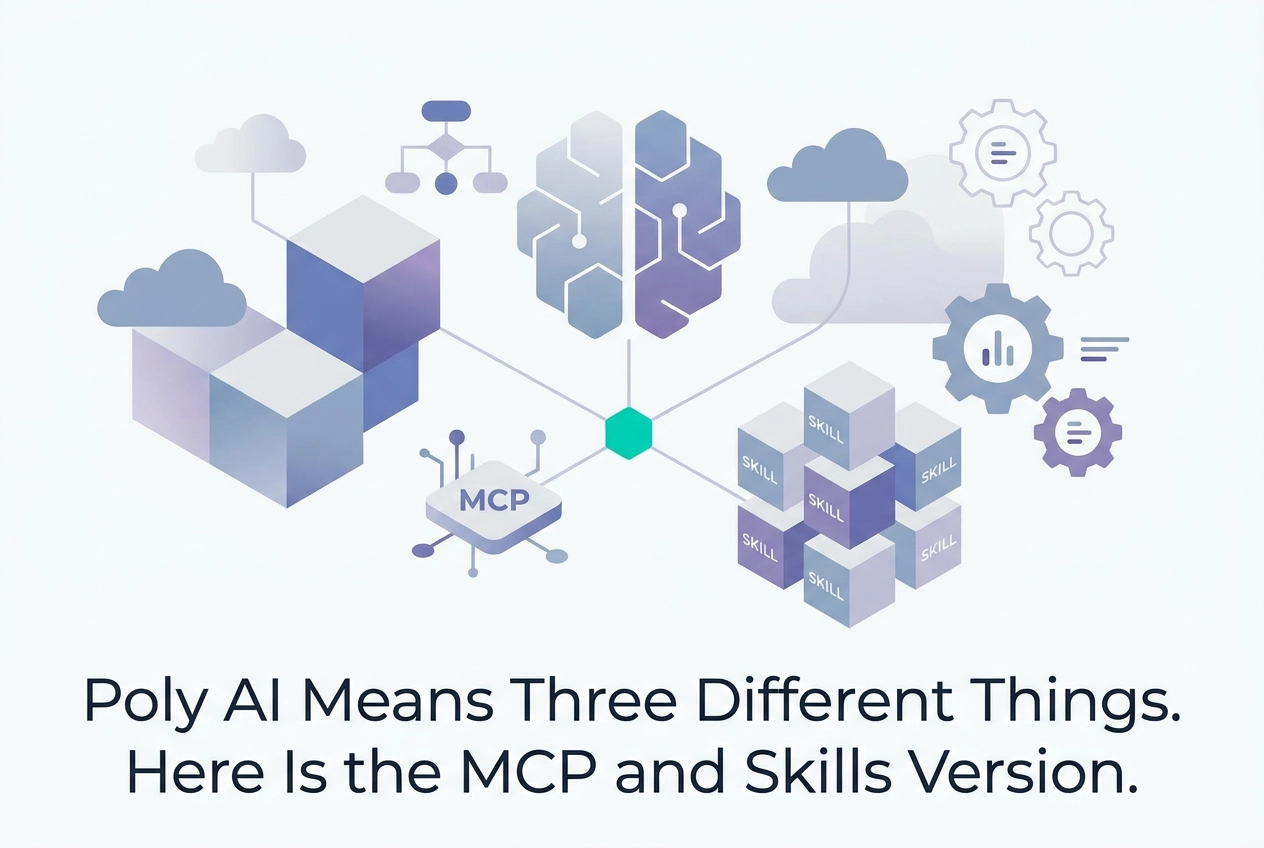
If you have searched for "poly ai" recently, you already know the confusion that follows. The term surfaces in at least three distinct contexts, each pointing to a completely different technology, product, or architectural concept. Without a clear map, developers and technical practitioners risk talking past each other entirely.
This post focuses on the definition that matters most for modern AI system design: poly ai as shorthand for agent infrastructure that stacks multiple Model Context Protocol (MCP) servers alongside multiple Agent Skills. Those are two distinct layers rather than two competing standards, and understanding what each one actually does, and where they meet, is increasingly important for anyone building or evaluating intelligent agent systems.
By the end of this analysis, you will have a working understanding of what MCP actually does, which is give an agent hands: tool calls, external API access, file reads, database queries. You will also understand how SKILL.md files encode procedural knowledge that loads only when a task calls for it, and why conflating those two layers leads to poor architectural decisions. Whether you are wiring MCP servers into Claude or Cursor or auditing a skill catalog before you ship, this breakdown will give you the technical clarity to move forward with confidence.
Three Audiences, One Search Term

Search for "poly AI" in 2026 and you land in three different rooms simultaneously. One group is researching PolyAI, the enterprise voice AI company building conversational agents for contact centers. A second group arrived from Polymarket, looking for prediction-market MCP tooling, such as the community-built Polymarket MCP servers that developers keep forking and adapting. The third group is using "poly" as shorthand for something architectural: multi-tool, multi-skill agent infrastructure. That third audience is who this post is written for.
If you are wiring MCP servers and SKILL.md files into Claude, Cursor, or a custom agent harness, the naming collision is not just a branding annoyance. It signals a real vocabulary problem in this space. Anthropic's own Agent Skills documentation maintains a deliberate separation between Tools and Agent Skills as parallel taxonomies, because they solve different problems at different layers. MCP tools are external actions: typed inputs, typed outputs, declared side effects. Agent skills are procedural knowledge bundles: sequencing logic, contextual triggers, domain heuristics encoded in markdown. Conflating them is one of the most common mistakes practitioners make when moving from prototype to production.
This post works through both layers precisely. By the end, you should be able to answer three questions: which layer handles which job, what does quality look like in each, and how do you wire both without hitting account-creation gates. The relationship between skills, tools, and MCP is now a common topic in practitioner education for good reason. Getting the taxonomy right before writing a single line of agent config saves significant debugging time downstream.
MCP vs. Agent Skills: The Debate Worth Having
The "MCP is Dead" framing is circulating in practitioner media right now, and it is drawing real traffic. Posts arguing that skills simply replace MCP keep appearing. The framing is wrong, but it earns clicks because it identifies a genuine architectural confusion that practitioners are running into in the wild. Addressing it directly is more useful than ignoring it.
The accurate distinction is mechanical, not philosophical. MCP gives agents hands: tool calls, external API access, file reads, web requests, database queries. A SKILL.md file gives agents judgment: a structured procedure encoded in markdown that tells the agent how to behave in a specific domain, loaded lazily so it does not burn context on every turn. Confusing these two layers leads to architectures that are either too complex or too brittle. They are not competing for the same job.
The spec timeline shows how fast this space moved. Anthropic introduced Claude Skills as its own feature, and an open Agent Skills standard followed. MCP itself moved to open, multi-vendor governance under the Linux Foundation. Compatible products now span several vendors and clients, including Claude, OpenAI Codex, GitHub Copilot, Cursor, Gemini CLI, and VS Code. Both standards went cross-vendor quickly. Neither is proprietary. Neither is going anywhere.
The original grievance that fueled the "replace MCP" narrative was real: early MCP implementations loaded every tool definition upfront, burning context before any actual work began. A server exposing hundreds of tools could spend a large share of the window on definitions alone. Anthropic addressed this with progressive discovery in Claude Code, lazy-loading tool definitions and expanding them only on demand. The efficiency gap closed. The architectural distinction remained.
Here is what stacking both layers looks like concretely. In a Cursor session, a locally launched MCP server entry follows this shape, with the package name standing in for whichever server you actually run:
{
 "mcpServers": {
 "market-data": {
 "command": "npx",
 "args": ["<your-market-data-mcp-server>"]
 }
 }
}
That pattern gives your agent live market data on demand. A SKILL.md file in your .cursor/skills/ directory then encodes the evaluation procedure: which markets to query, how to weight implied probabilities, what threshold triggers an action, what to log. One entry supplies capability. The other supplies discipline. Neither works as well without the other. The layering is explicit in practice: skills can encode instructions for using MCP tools, which makes the complementary relationship structural rather than incidental.
This is where the "poly AI" framing becomes a useful mental model for production agent infrastructure. Real production agents do not run one MCP server and one skill. They run multiple MCP servers covering distinct capability domains, alongside multiple SKILL.md files covering distinct procedural domains. A Cursor session might wire a file-system server, a web-search server, and a domain-specific data server simultaneously, while three separate skills govern how the agent approaches code review, research summarisation, and data evaluation respectively. Polyglot tooling is the default architecture, not an advanced configuration. Explainers on Agent Skills versus MCP draw steady attention, which suggests practitioners are actively working through this split rather than treating it as settled.
The Linux Foundation governance matters for one concrete reason: it means the protocol cannot be unilaterally revoked or forked into a proprietary direction by a single vendor. For practitioners wiring long-lived production agents, that stability is an architectural input, not a footnote. Build on both layers. They are complementary by design, open by governance, and increasingly the default stack for any agent doing real work.
A Flooded Catalog Is Not a Curated One
Public directories index enormous numbers of skill files scraped from GitHub. That volume is not an achievement. It is a description of a problem.
Volume Without Quality
Published skill files vary enormously in quality, and many carry defects. Curated skills tend to produce more reliable agent behaviour than uncurated equivalents pulled straight out of a search result. That gap is not marginal. It is the difference between a production agent and a demo that breaks in front of a customer. Every developer wiring skills into Claude or Cursor absorbs that quality problem directly into their product.
The security picture is worse than the quality picture. Audits of public skill files routinely surface large numbers of issues, and prompt injection is among them. Prompt injection is not a theoretical concern in this context. An agent that loads an injected skill can be redirected mid-task by the skill itself. That is an architectural attack surface, not a style point.
The Directory Pattern and Its Limits
The dominant operational pattern across public skills directories is consistent: scrape GitHub, run automated scans of limited depth, publish a listing, disclaim liability. It is common to see a listing surface a security warning and, in the same breath, disclaim that its scan results amount to any kind of security certification. Developers pull copies of code that a directory's own scanner flagged but could not fully evaluate. Automated scanning surfacing a warning while simultaneously disclaiming the scan's validity is a precise description of false confidence. The developer sees a scan happened. The developer does not see what the scan missed.
What Provenance Actually Means
"Open on GitHub, built by one author" means something specific and auditable. The diff history is public. Every change is attributed. The author is identifiable. There is no aggregation-from-unknown-sources problem because nothing was aggregated. The 138 SKILL.md files at Moltline Studio sit open on GitHub, written and owned by one person, with no scraping pipeline between the author and the file you load into your agent. Anyone can read the commit history, open a pull request, or file an issue. That is a level of provenance no directory can offer on scraped content, because a directory does not control what it indexes.
Curation as Competitive Advantage
Distribution in the skills ecosystem is a solved problem. GitHub is free. A directory can index a million files overnight. What is not solved is quality and security. If you are building a production agent and you choose skills based on GitHub star counts or directory listings, you are accepting a performance and security penalty without being told the cost. Curation is the current competitive axis precisely because the cost of not curating lands on whoever ships the agent.
Zero Friction as an Architectural Choice
MCP setup in 2026 is still a manual chore. Beginner-level walkthroughs for configuring MCP clients in Claude, Cursor, and Codex CLI are published as introductory content, not because the ecosystem is mature, but because the setup UX has not been solved at the platform level. The typical install path requires cloning a repository, installing dependencies, setting environment variables, and pointing the client at a local process. Documentation patches over the friction. It does not remove it.
One URL, No Account, No API Key
Moltline Studio takes a different approach. Paste a single URL into any MCP client config. No account creation. No API key. Moltline Studio hosts 22 MCP servers exposing 160 tools in total, 110 of them free, and the endpoint directory at https://mcp.moltlinestudio.com lists every server. The entire install sequence collapses to one config entry.
For Claude (claude_desktop_config.json):
{
 "mcpServers": {
 "moltline": {
 "url": "https://mcp.moltlinestudio.com/catalog"
 }
 }
}
For Cursor (~/.cursor/mcp.json):
{
 "mcpServers": {
 "moltline": {
 "url": "https://mcp.moltlinestudio.com/catalog"
 }
 }
}
That is the entire configuration. No local process, no dependency install, no credential management. The architectural choice here is deliberate: hosted MCP removes the last-mile friction that currently lives between a developer reading about a tool and actually using it.
Premium Access Without a Human in the Loop
The 50 premium tools are reachable two ways, and the same licence sits behind both. A human developer takes All-Access at $19 a month, billed monthly through NOWPayments in cryptocurrency and cancellable at any time; one key unlocks the premium tools on all 22 servers. An agent buys the identical licence without a human present, over x402 — and the mechanics are worth being precise about, because the obvious guess is wrong. The MCP tool endpoint does not serve the 402. That sequence runs in four steps:
The agent calls a premium tool and gets back HTTP 200 with a machine-readable refusal. The transport is carrying a JSON-RPC result, so the status stays 200 by design; the body names the price and points at
https://moltlinestudio.com/api.The agent requests that resource and receives HTTP 402 with a structured payment specification: amount, destination wallet, and chain — carried in both the body and the response headers.
The agent signs a payment payload and retries the request with the transaction hash attached in the
X-PAYMENTheader.The payment settles on-chain in USDC on Base, and the licence key is returned in the response.
What that buys is the same month of access a person would buy, settled machine-to-machine. It is not a per-call meter: an agent that wants a single premium call still buys the month.
The x402 protocol puts a long-reserved HTTP status code to work. The exchange settles on-chain. No login. No subscription form. No human reads the payment challenge.
Why This Is an Architectural Requirement, Not a Feature
Applying x402 to MCP premium-tier access is still an emerging pattern. The underlying problem it addresses is well-understood: an agent that must pause mid-task and request human authorization for a payment is not a fully autonomous agent. It has a hard dependency on human availability at the exact moment it needs a new capability.
Human approval requirements are a core failure mode for autonomous agents, because most payment flows require a manual confirmation step. The x402 pattern removes that dependency entirely. The agent discovers a premium tool, pays for access, and continues execution without interruption.
The practical implication for agent developers is direct. If you are building an agent that acquires capabilities at runtime, the payment rail cannot require a human in the loop. Zero-friction access at the free tier addresses the onboarding problem. Machine-readable payment challenges address the autonomy problem at the premium tier. Both are architectural decisions, not UX polish.
What Poly AI Infrastructure Looks Like in a Real Stack
A production agent stack in 2026 is not a single model with a system prompt. It is a composition: multiple MCP servers covering distinct domains, multiple SKILL.md files covering distinct procedures, and a client that can route between them. "Poly AI" here is an infrastructure description, not a brand category. A developer wiring Claude into a code-review workflow might pull from one MCP server for repository tooling, a second for search, and a third for deployment operations, each paired with specific SKILL.md files that encode the procedures those tools support.
Progressive Disclosure at Scale
The scaling constraint in a large skill library is context. Pre-loading 138 full skill definitions at session start is not viable. The SKILL.md spec was designed around progressive disclosure, which Anthropic describes as three levels: at initialisation the client sees only each skill's name and description; the full SKILL.md body loads when a skill matches the current task; and any bundled reference files load only if the task actually reaches them. This keeps the active context window lean regardless of catalog size, and it is why the pattern has become the default across compatible clients. Context engineering, not model selection, is the primary constraint in production agent work, which makes lazy loading an architectural necessity rather than an optional optimisation.
What Is Available Now
All 138 Moltline SKILL.md files are open to read on GitHub. Any skills-compatible client, including Claude, Cursor, Codex, and Gemini CLI, can import them directly. No signup, no account, no API key. The files cover distinct procedures across domains and are free to use as-is in any agent, personal or commercial, under the Moltline Free Skills License.
Starting Points for Practitioners
The concrete sequence before committing to any paid tooling:
Browse the SKILL.md repo on GitHub directly
Run the free agent-readiness checker at moltlinestudio.com/agent-check.html against any vendor domain your agent will depend on, to see whether an agent can discover, read, and buy from it
Paste an MCP server URL into your client config
Test the 110 free tools, which require no account and no API key, before evaluating the premium tier
That second step matters more than its ordering suggests. With the discovery layer as crowded as it is, the checker answers the prior question about any vendor: not whether its tools sound good, but whether an autonomous agent can actually reach and use that vendor's surfaces.
Takeaways
MCP handles capability. Agent Skills handle behavior. You need both. The "MCP is dead" framing is wrong, and building on that assumption will leave your agent half-assembled.
Public skill catalogs carry real risk. Uneven quality across scraped skill files, combined with prompt injection exposure, makes source auditing a production requirement, not an optional step.
Zero-friction entry exists. Paste one MCP URL into your client config and reach 110 free tools, no account and no API key. Agent-native payment via x402 extends that to premium capabilities: an autonomous agent can discover, pay, and activate without human authorization in the loop.
Three free starting points require no signup: the open SKILL.md catalog on GitHub, the agent-readiness checker, and the MCP server URL. Start there.
Conclusion
The term "poly ai" carries real weight in modern system design, but only if you know which version you are working with. Here are the key takeaways to carry forward.
First, MCP is the capability layer: a protocol through which an agent calls external tools and reads external resources, from API requests to file reads to database queries. Second, Agent Skills are the procedural layer: SKILL.md files that encode how to approach a domain, loaded only when a task matches so they do not burn context on every turn. Third, these two layers complement each other in production stacks rather than compete for the same job.
Understanding the distinction is not just semantic. It shapes how you architect, evaluate, and communicate about your systems.
Your next step is concrete: run the agent-readiness checker against the domains your agent will lean on, paste one hosted MCP URL into your config, and test the 110 free tools before you evaluate anything paid.
Clarity here is a genuine competitive advantage. Build with precision, and your systems will reflect it.